

What is the decoy effect? A clever pricing strategy in business.
Reading time: 6 minutes
Currently, the decoy effect is a technique used by businesses across various industries. So, what is the decoy effect ? How should you price your decoys to improve your sales?

Vietnam’s leading AI-powered multi-channel virtual call center.
What is the decoy effect?
The Decoy Effect, also known as the asymmetric advantage, is a common tactic in business that targets consumer psychology to attract customers and increase sales. Instead of offering customers a choice between product A or B of the same type, this effect introduces a third product as bait. This leads customers to accept a higher price while still maintaining satisfaction.
What is the decoy effect? A clever pricing strategy in business.
How the decoy effect works
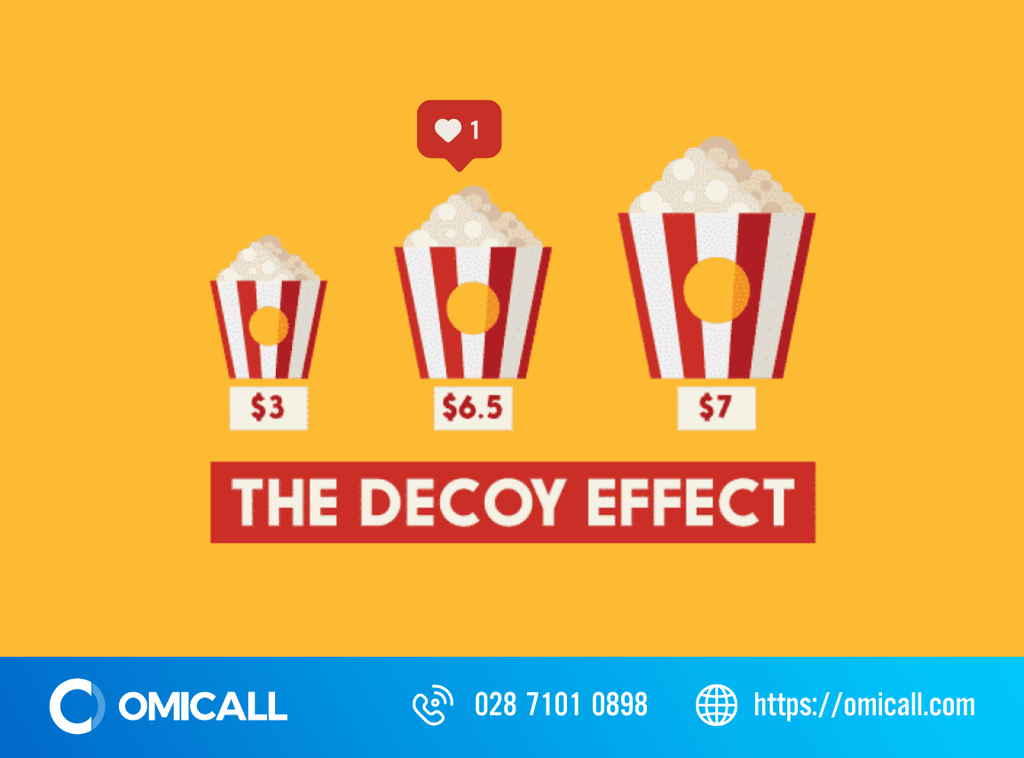
When consumers are faced with many choices, they often become overwhelmed. Therefore, consumers tend to simplify the process by establishing a few criteria (such as price and quantity) to determine the best value for their money. Capitalizing on this psychology, the decoy effect gives you the feeling that you are making a rational and wise choice.
The decoy effect works on the principle of comparison. When customers are presented with two choices, they tend to value the better option more highly. Therefore, the less attractive option acts as a “bait” to make the better option seem more appealing.
How the decoy effect works
Examples of the decoy effect
Suppose a business card printing company offers the following three price options:
- 100 business cards worth 200,000 VND with standard quality;
- 200 business cards for a funeral, priced at 410,000 VND, in HD quality.
- 200 business cards for 350,000 VND, standard quality.
The final option is a decoy, making consumers feel like they need a high-quality business card option. Therefore, they naturally lean towards the second option, which is slightly more expensive but offers HD quality.
Effective decoy pricing strategies
Tiered pricing
Products are priced at different levels, based on their quality or features. You can make higher-level products more attractive by showing that they offer more features than their price suggests.
Package pricing
Let’s say you’re an online bicycle equipment business. You advertise your products as follows:
- Unbranded cycling jersey: 800,000 VND;
- Branded cycling jersey: 1,500,000 VND;
- Package deal – Branded shirt and cycling gloves: 1,700,000 VND.
The gloves are typically sold for 500,000 VND. The branded shirt is just a lure. The allure effect makes the higher-priced option in the package seem like the best value, resulting in higher overall customer spending.
Left-digit effect
Consumers are often attracted by the first digit, such as 399,000 VND instead of 400,000 VND. Theoretically, the seller is losing 1,000 VND. However, in reality, the seller will fully recoup this loss as the number of orders increases. That is the main objective of this effect.
This effect will only yield the desired results when you develop a detailed implementation plan. You need to conduct in-depth analysis of your target market and purchasing behavior. This will allow you to determine a specific direction and create an effective marketing and sales plan.
The 100 Rule
This strategy not only utilizes the decoy effect but also cleverly targets customer psychology. Since customers tend to be impressed by higher numbers, this strategy helps convert them into buyers. Businesses can flexibly choose from the following two discount methods to suit their needs:
- If the discount is lower than the product price , you should use a percentage discount instead.
- If the discount amount is in the millions of VND , you should use a fixed-amount discount instead of a percentage discount.
Advantages and Disadvantages of the Decoy Effect
A decoy pricing strategy can offer several significant benefits to your business, including:
- Attention-grabbing: This strategy aims to attract customer attention and increase interest in the product/service, especially higher-priced products;
- Highly effective: Because the lure allows shoppers to compare it with your target product, it can speed up the consumer’s decision-making process;
- Increased sales: When a third option is presented, a combination of the first two at a reasonable price, most people tend to pay attention to and purchase this combination.
Advantages and Disadvantages of the Decoy Effect
In addition, this pricing strategy carries several risks, as follows:
- Customer psychology varies: Accurately reading customer psychology is challenging. Your target audience may react in unexpected ways. That’s why you should experiment and adjust your strategy as you learn about customer reactions.
- Customer dissatisfaction. Abusing this strategy leads to customer dissatisfaction. They may feel cheated about the quality of your product compared to the price they paid. Customers also face the problem of being overwhelmed by too many choices.
In conclusion
Understanding the decoy effect will help you develop an effective marketing strategy, attracting customers and increasing sales. However, businesses need to use this effect responsibly and avoid overuse to prevent misleading customers.
VIHAT TECHNOLOGY Co., Ltd
Headquarters: ViHAT Building – 06 Street No. 16 (Him Lam Residential Area) – Hiep Binh Chanh Ward – Thu Duc District – Ho Chi Minh City
Hanoi Branch: Floor 15, LADECO Building, 266 Doi Can, Ba Dinh, Hanoi
Cambodia Branch: Thida Rath #154 St. 33MC, Sangkat Steung Meanchey, Khan Mean Chey, Phnom Penh

-
 What is TikTok advertising? Advertising policies and how it works.
-
 Exploring Conceptual Selling – Understanding Modern Sales Trends Correctly
-
 What is a KOC? Distinguishing between KOLs and KOCs.
-
 What Are Customer Insights? Revealing How to Effectively Uncover Them
-
 What is Digital Marketing? 10 Effective Forms of Digital Marketing
-
 What is Online Marketing? Types of Online Marketing





