

Building an optimal sales funnel for your business.
Reading time: 10 minutes
Use the Up/Down arrow keys to increase or decrease the volume.
Purchasing decisions don’t happen spontaneously or emotionally. You need to build an optimal sales funnel to satisfy the customer journey.
By understanding each level of the sales funnel, we can create steps that guide customers closer to the bottom and ultimately lead them to a purchase decision. When this happens, it significantly impacts the company’s sales. Building and developing a sales funnel is crucial in business; let’s delve deeper into this “ultimate weapon.”
What is a sales funnel?
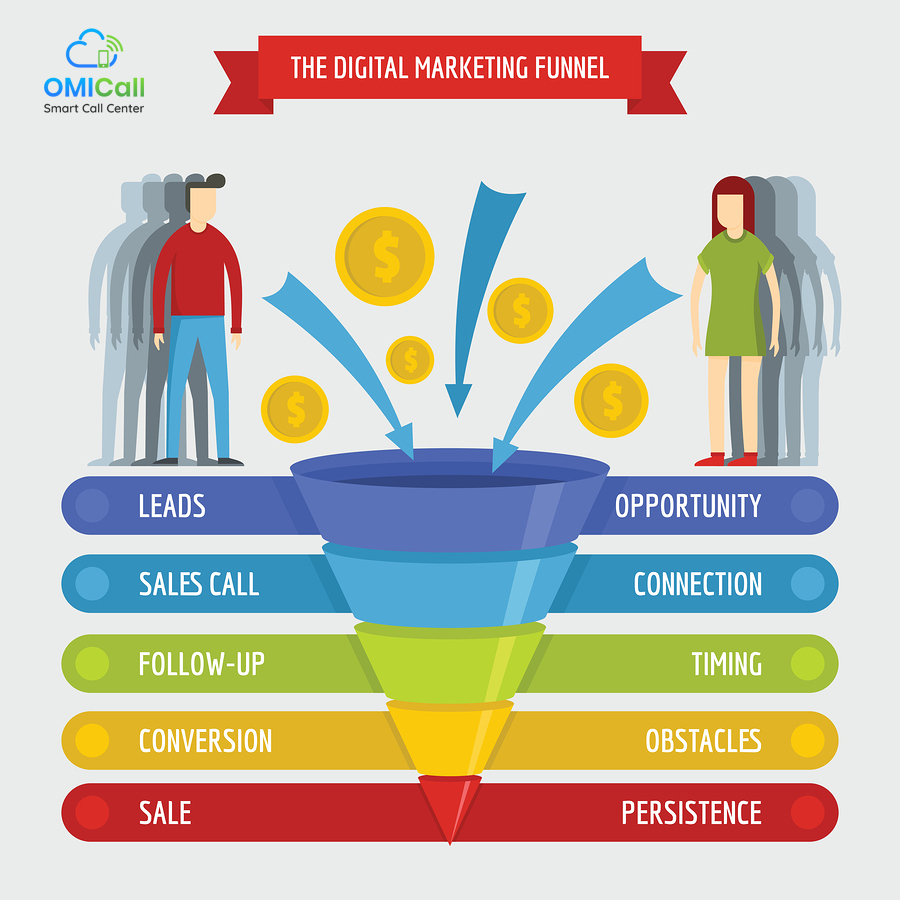
Phễu bán hàng (Sales Funnel) là một khái niệm Marketing vạch ra hành trình của A sales funnel is a marketing concept that outlines the customer journey when making any purchasing decision. The funnel model symbolizes a large number of customers who access your product at the top of the funnel. However, only a small number complete the purchase process at the bottom of the funnel.
The likelihood of a customer making a final decision increases with each stage of the funnel. The further down the funnel you go, the higher the commitment to purchase. Your sales funnel can take the form of:
- Retail store
- Sales team
- Website
- Personal advice
- visits
Any marketing channel can be part of a sales funnel. One level of the funnel can span multiple channels. The four basic levels of a sales funnel are:
- Awareness
- Interest
- Decision
- Action
Why is the sales funnel important?
If you’re a business owner, you’ve undoubtedly experienced the pain of missed sales opportunities. You’ve spent a large budget on advertising, organized numerous webinars, built a website, and so on, but ultimately, potential customers still leave without buying anything.
With a sales funnel , that still happens, but it’s significantly reduced. A sales funnel helps you understand your potential customers—what they think, how they act. Understanding your target customer insights allows you to develop the right marketing channels and generate conversions. Additionally, you can assess gaps in your process, improve it, and focus on key profit touchpoints.
How the sales funnel works
Although many terms are used to describe the different stages of the sales funnel , we’ll go with the four most common terms to explain how each stage works as the consumer moves from visitor to prospect to ultimately buyer.
A visitor arrives at your website through a Google search or social media link. He or she is now a potential customer. The visitor might view a few of your blog posts or browse your product listings. At some point, you give them the opportunity to sign up.
If visitors fill out the form, they become potential customers. Now you can market to those customers outside of your website, such as via email, phone, text message – or all three.
Potential customers are more likely to return to your website when you contact them with attractive offers, information about new blog posts, or other messages such as discount codes.
The sales funnel will narrow as customers move through it. This is partly because there are more customers at the top of the funnel and fewer as they move down. But it’s also because your message becomes increasingly targeted to your ideal customers.
4 stages of the sales funnel
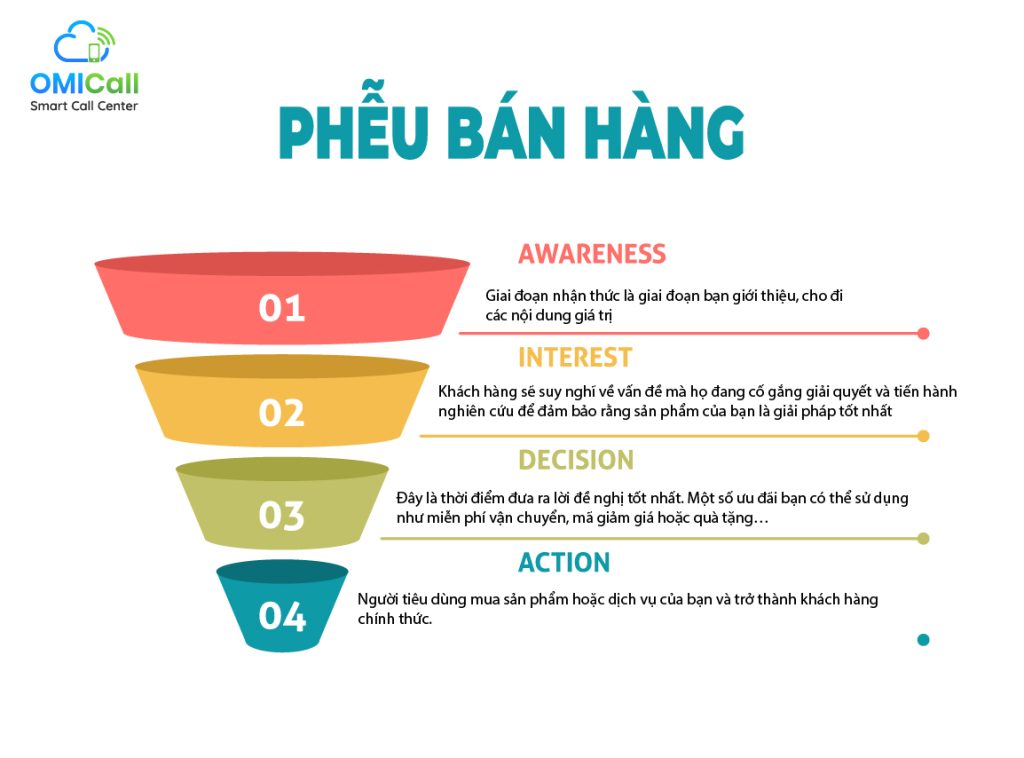
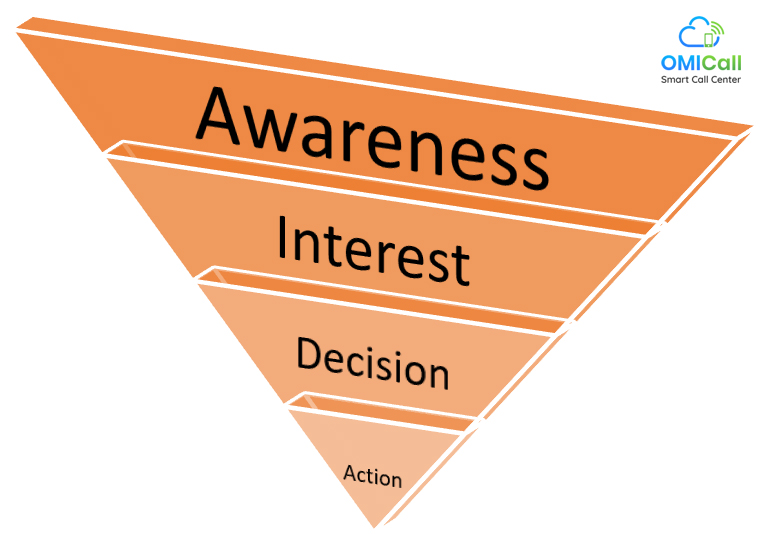
The four main stages of the sales funnel are often referred to by the acronym AIDA: Awareness, Interest, Decision, Action. These four stages reflect the customer’s thinking and decision-making process.
Each stage requires different marketing strategies. It’s like wanting appetizers before the main course and dessert at the end. Analyze each stage of the sales funnel in detail .
Awareness
This is the time to capture your customers’ attention. This could be through a blog post, a Facebook post, or a video, etc. Through these pieces of content, potential customers will learn about your business and what you offer.
If your content is engaging, customers may make a purchase decision right away. If not, they will continue researching the products and services you offer. Typically, the awareness stage is when you introduce and deliver valuable content. The most important thing isn’t selling at this point, but attracting customers to return and remember you when they need products or solutions.
Interest
When consumers reach the interest stage in the sales funnel , they are doing research, comparing purchases, and thinking about their options. This is the time to provide them with valuable content that helps them research the product. During this stage, customers will search for solutions on Google. They will think about the problem they are trying to solve and conduct research to ensure that your product is the best solution. Optimize your SEO and provide as much useful information as possible. Trying to push sales at this stage might be the quickest way to drive customers away.
Decision
The crucial stage of the sales funnel is when the customer is ready to buy. They might be considering two or three options, including your product. This is the best time to make an offer. Some incentives you can use include free shipping, discount codes, or gifts… Whatever the form, make it feel attractive to the customer.
Action
At the bottom of the sales funnel, customers take action. They buy your product or service and become full customers.
However, guiding the consumer to the final stage doesn’t mean your job ends there. This customer may repurchase your product in the future or recommend your service to their friends. Therefore, focus on retaining the customer. Express gratitude for the purchase, call to check in, and provide technical support if needed.
How to build a sales funnel
Step 1: Analyze the behavior of your target customers.
The more you know about your target audience, the more effective your sales funnel becomes. We can’t market to everyone. We need to target the right customer segment. To do that, we must analyze and research consumer behavior, creating a profile of our target customer. Which social media platforms do they usually visit? How many seconds do they spend reading ads? What are those ads?
Your message should reach as many relevant people as possible. Imagine if you can convert 2 out of 10 potential customers; that number could increase to 20 out of 100, or 200 out of 1000.
Step 2: Attract the customer’s attention
The only way for your sales funnel to work is to attract customers to it. That means the content you deliver must be truly engaging.
Create content using an inbound model and publish it across all platforms. Diversify your content, including images, infographics, and videos. If you’re willing to spend more, run ads. The ideal place to run those ads depends on where your target audience is located.
Step 3: Build the Landing Page
Your advertising or content needs to lead customers to a specific address. A landing page is where you can best convey your message. The content here will drive the buyer’s decision-making process. It must guide visitors to a specific action. You need to provide detailed instructions on what customers need to do: fill out a form, download an ebook, watch videos… anything that serves as a bridge to the next step.
Step 4: Implement the Email Marketing Campaign
Market your potential customers through email by delivering great content. Send emails regularly, but not too often. One or two emails a week is sufficient. Increase sales by understanding your market beforehand. What do they want to learn? What obstacles and objections do you need to overcome to convince them to buy? At the end of your email campaign, include a compelling offer. This is the piece of content that will inspire your potential customers to take action.
Step 5: Stay in touch
Don’t forget about your existing customers. Instead, keep in touch with them. Thank them for their purchases, offer them additional discount codes, and engage them in your promotions or events.
Measuring the success of the sales funnel.
Your sales funnel may need adjustments as your business grows; learn more about your customers and diversify your products and services. One way to measure the success of your sales funnel is to track conversion rates from your campaigns.
For example, how many people signed up for your email list after clicking through to your Facebook Ads? Pay close attention to conversion rates at each stage of the sales funnel :
- Are you capturing enough consumer attention with your original content?
- Do your potential customers trust you enough to give you their contact information?
- Have you driven sales through email campaigns and other marketing efforts?
- Will your current customers return and buy from you again?
Knowing the answers to these questions will tell you where you need to adjust your sales funnel.
A powerful tool for businesses to track data and customer journeys in marketing campaigns is the OMICall call center. With real-time reporting features, you can always monitor the performance of your telesales or multi-channel sales campaigns.
Why do you need to optimize your Sales Funnel?
The truth is: Your potential customers have many choices. You want them to choose your product or service, but you can’t force them. Instead, you have to do effective marketing. Without an optimized sales funnel , you’re just guessing what your potential customers want. If you’re wrong, you’ll waste money without achieving results.
This is especially important for the landing pages we’ve discussed. If they aren’t optimized for conversions, most people will just click and leave.
How to optimize your sales funnel
You can optimize your sales funnel in many ways. The most important are at the transition points in the funnel.
Take Facebook advertising as an example. Don’t just run one ad. Run 10 or 20 campaigns. The campaign content can be similar, but target different buyer personalities. Use Facebook’s targeting features to ensure those ads appear to your target audience.
Test your landing pages. This takes time, but you’ll reach more people and convert leads more reliably.
Based on the open and click rates of your email campaigns, change your language, images, offers, and layout to find the email templates that receive the most responses.
You’re creating content, whether paid or not, to draw attention to your brand and encourage people to click the CTA button. If the content isn’t delivering good results, create new content.
And finally, track your customer retention rates. Do people return and buy from you a second, fifth, and twentieth time? Do they refer their friends?
Your goal is to always keep your brand in check. If you never let your audience down, they’ll have no reason to look elsewhere.
In conclusion
Creating and optimizing a sales funnel takes time. It’s hard work. But it’s the only way to survive in a competitive market. Believe it or not, a small detail like font choice can affect conversions. And if you expect people to buy your product too quickly, you’ll drive them away.
Take the time to build a sales funnel that represents what you want and what your audience wants. Optimize the funnel over time, adjusting your approach to the stages of the sales funnel and understanding why your efforts aren’t working.
OMICall is a provider of intelligent virtual call center services, a great tool to support customer care and sales. Contact us for detailed advice on building your sales funnel .
VIHAT TECHNOLOGY Co., Ltd
Headquarters: ViHAT Building – 06 Street No. 16 (Him Lam Residential Area) – Hiep Binh Chanh Ward – Thu Duc District – Ho Chi Minh City
Hanoi Branch: Floor 15, LADECO Building, 266 Doi Can, Ba Dinh, Hanoi
Cambodia Branch: Thida Rath #154 St. 33MC, Sangkat Steung Meanchey, Khan Mean Chey, Phnom Penh

-
 What is TikTok advertising? Advertising policies and how it works.
-
 Exploring Conceptual Selling – Understanding Modern Sales Trends Correctly
-
 What is a KOC? Distinguishing between KOLs and KOCs.
-
 What Are Customer Insights? Revealing How to Effectively Uncover Them
-
 What is Digital Marketing? 10 Effective Forms of Digital Marketing
-
 What is Online Marketing? Types of Online Marketing





