
Telesales Software: Features, Selection Guide & Managing Outbound Teams in 2026
Reading time: 6 minutes
A 10-person telesales team can make 40–60 calls per person per day. The same team, using specialized software, can achieve 1.5 to 2 times that, with full recording and automated reporting. The difference isn’t in effort—it’s in the tools. This article summarizes everything you need to know about telesales software in 2026: core features, how to choose, and the legally compliant campaign operation process.
What is telesales software? It’s specialized software for outbound calling teams: automatic dialing from a list (auto dialer), data distribution, call script display, full recording, and real-time performance statistics for each employee. Modern software even uses AI to score 100% of calls instead of managing a few percent of sample calls.
Quick Summary
- Target audience: Outbound teams of 3 or more—handling sales, payment reminders, surveys, and existing database outreach.
- 6 core features: Auto-dialer, lead distribution, on-screen scripts, call recording with AI scoring, call status management, and performance reporting.
- Typical impact: 50–100% increase in daily call volume by eliminating manual dialing and note-taking.
- Compliance: Fully compliant with Decree 91/2020—uses legitimately sourced data and respects opt-out requests.
- Cost: Per user/month + call charges; choose a version integrated into the existing call center platform to avoid integration fees.
What is telesales software?
Unlike customer service call centers (which primarily handle inbound calls), telesales software is optimized for campaign-based outbound calling: lists of thousands of numbers are uploaded, the system automatically dials them sequentially, and agents focus solely on the conversation. After each call, the agent selects a status (e.g., interested, callback scheduled, rejected), and the system automatically records the outcome and schedules the next step.
Effective telesales software always integrates two platforms: a telephony system (for stable calling and competitive rates) and a customer management system (to ensure data continuity after the campaign ends).
6 core features
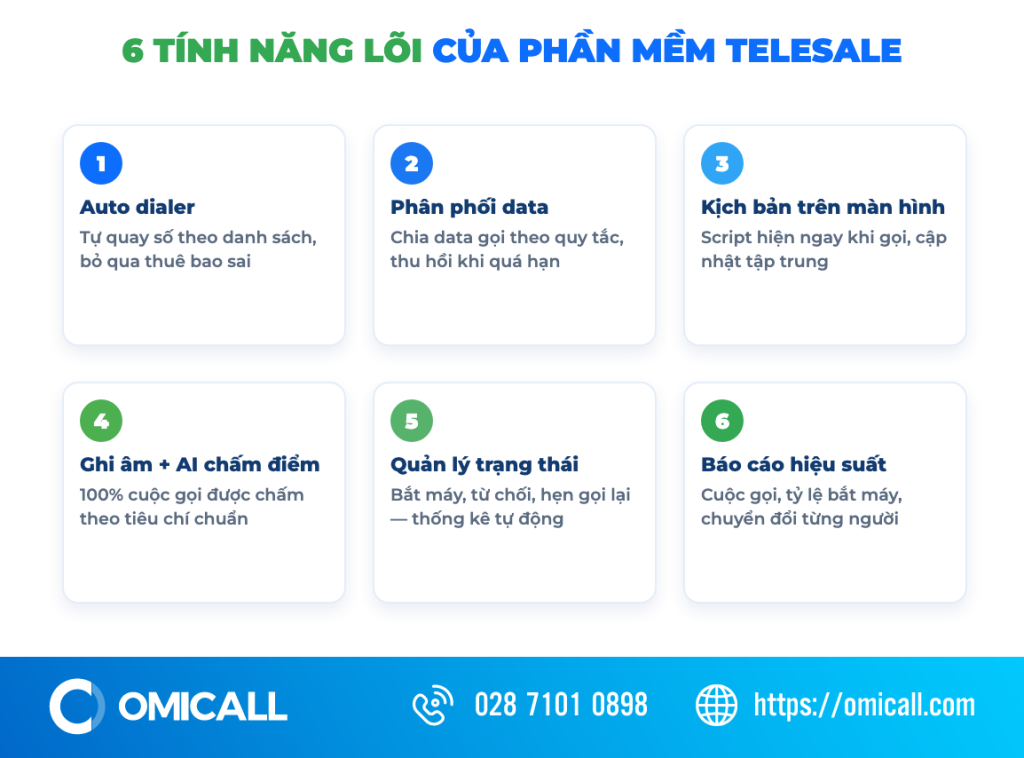
6 features that boost telesales productivity
Auto-dialer. Automatically dials numbers from a list and skips invalid numbers or busy lines—saving agents the 15–20 seconds spent dialing for each call. This is the single biggest driver of productivity gains.
Lead distribution. Allocates lists based on specific rules, prevents duplicate calls (ensuring two agents don’t contact the same prospect), and automatically reclaims uncalled leads that have expired.
On-screen scripts. Scripts and objection-handling responses appear immediately upon calling—helping new hires ramp up quickly and ensuring consistent messaging across the team.
Call recording + AI scoring. 100% of calls are recorded and scored against criteria (standard greeting, key points covered, attitude)—managers only need to review flagged calls.
Status management. Tracks outcomes like answered/rejected/interested/callback scheduled—with automated statistics generated by campaign and lead list.
Performance reporting. Tracks call volume, actual talk time, and individual conversion rates—dashboards instantly reveal who needs support.
How is AI transforming telesales?
- AI Quality Scoring: Covers 100% of calls at a fraction of the cost of manual QA.
- Automated Call Summaries: Eliminates sketchy handwritten notes; ensures seamless data handovers between shifts.
- Sentiment Analysis: Detects frustrated customers, allowing for adjustments to scripts and calling frequency.
- Callbot Data Filtering: AI screens cold leads first, transferring only responsive prospects to human agents—enabling staff to focus on high-value calls.
How to choose telesales software
| Criteria | Needs to be checked |
|---|---|
| Calling platform | Runs on a stable cloud-based PBX, offers competitive call rates, and supports premium phone numbers. |
| Auto dialer | Scalable dialing modes; live demos using your own list. |
| Vietnamese AI | Accurate transcription and scoring that recognizes your customers’ regional accents. |
| CRM Integration | Campaign results flow directly into customer records, eliminating the need for manual file exports. |
| Expense | Total cost = software + call charges; based on the same monthly call volume. |
Running a 5-step campaign
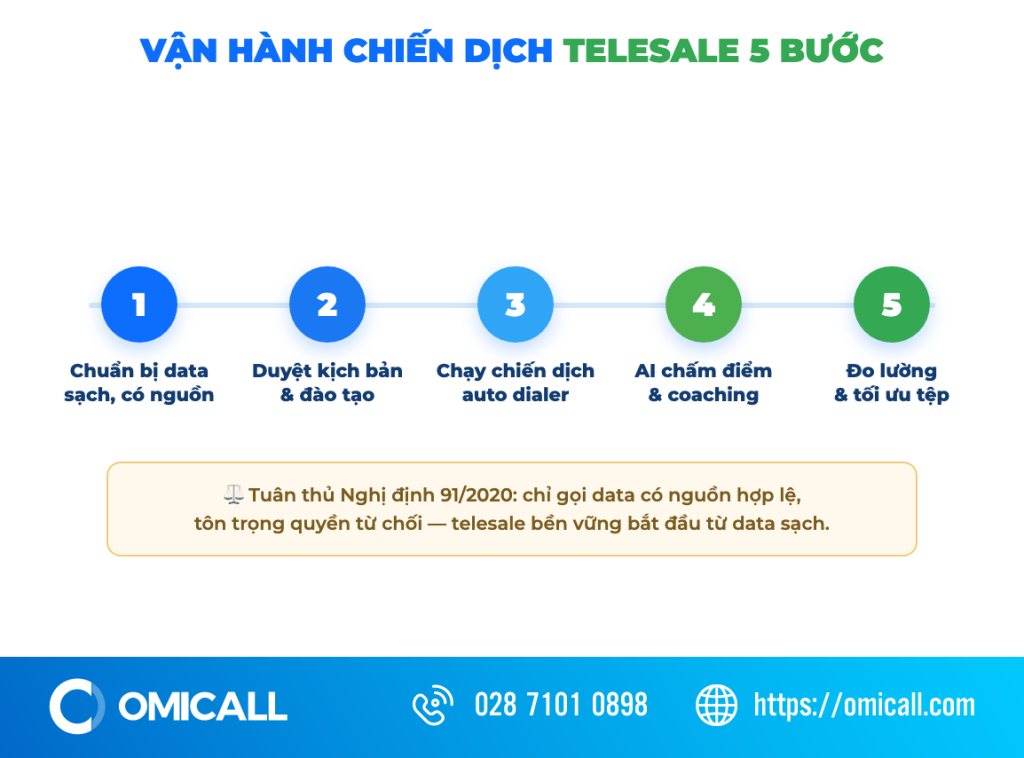
An effective telesales campaign starts with clean data
Step 1 — Clean, sourced data. Remove duplicates, standardize phone numbers, and clearly document the data source. Data quality determines 70% of the campaign’s results.
Step 2 — Scripting and training. Prepare a main script plus responses for the 10 most common objections; conduct role-playing sessions before agents go live.
Step 3 — Auto-dialer execution. Start with a small data batch to measure pick-up rates across different time slots, then expand into “golden hours” (peak times).
Step 4 — AI scoring and daily coaching. Review 2–3 low-scoring calls and 1 excellent call together every morning—this helps the team improve week by week.
Step 5 — Measurement and data optimization. Track pick-up, interest, and conversion rates by data source—discard underperforming lists and scale up high-performing ones.
- Compliant outbound calling
Sustainable telesales must be legally grounded: Decree 91/2020/NĐ-CP regulates anti-spam calling—only make promotional calls to those not on the “do-not-call” list, clearly identify yourself, and respect requests to stop calling; and Decree 13/2023/NĐ-CP requires that customer data be collected from legitimate sources. Best practices: do not purchase unverified/floating data, document the source for every list, and configure a Do-Not-Call (DNC) list directly within the software.
- Frequently Asked Questions
- How does telesales software differ from a standard call center system?
A standard call center handles general inbound and outbound calls; telesales software adds a campaign management layer—including auto-dialers, data distribution, scripting, and call scoring—specifically optimized for high-volume outbound teams. 2. Is it suitable for teams of 3–5 people?
Yes—auto-dialers and scheduling reminders are effective even at a small scale; since costs are based on the number of users, the initial investment is low. - Do auto-dialers annoy customers?
No, if used correctly: the system simply handles the dialing for the agent, so the customer still speaks to a real person immediately upon answering. - How much does telesales software cost?
It is priced per user/month plus call charges. Comparisons should be based on call volume; integrated PBX and CRM platforms usually offer the best overall value. - How can I increase the call answer rate?
Use a reputable landline number, select time slots based on actual statistics, and “warm up” your data with a text message before calling. - How does AI call scoring work?
The system transcribes recordings into text, evaluates them against specific criteria (greetings, mandatory information, prohibited words, attitude), and scores each call—flagging specific calls for management review. - Conclusion
Telesales software is the most effective productivity booster for outbound teams: it enables higher call volumes, consistent quality, and data-driven insights rather than guesswork. By choosing a solution that integrates PBX and CRM platforms, following a 5-step process, and maintaining clean data, your telesales team can achieve sustainable growth instead of simply “burning through” leads.
OMICall provides telesales software built on an AI-powered PBX platform, featuring auto-dialing, lead distribution, AI-based scoring for 100% of calls, and real-time reporting. Contact us for a demo using your business’s actual calling scripts.
For more details, please contact:
VIHAT TECHNOLOGY Co., Ltd
Headquarters: ViHAT Building – 06 Street No. 16 (Him Lam Residential Area) – Hiep Binh Chanh Ward – Thu Duc District – Ho Chi Minh City
Hanoi Branch: Floor 15, LADECO Building, 266 Doi Can, Ba Dinh, Hanoi
Cambodia Branch: Thida Rath #154 St. 33MC, Sangkat Steung Meanchey, Khan Mean Chey, Phnom Penh

-
 What is TikTok advertising? Advertising policies and how it works.
-
 Exploring Conceptual Selling – Understanding Modern Sales Trends Correctly
-
 What is a KOC? Distinguishing between KOLs and KOCs.
-
 What Are Customer Insights? Revealing How to Effectively Uncover Them
-
 What is Digital Marketing? 10 Effective Forms of Digital Marketing
-
 What is Online Marketing? Types of Online Marketing





