What is a CDP? The key to better understanding your customers.
Reading time: 6 minutes
In today’s digital age, where customer data is incredibly valuable, a Customer Data Program (CDP) helps businesses obtain a wealth of curated customer information based on key insights. This allows businesses to develop effective marketing strategies. So, what is a CDP ? How do you set up a CDP system? This article will answer those questions.
What is CDP?
CDP stands for Customer Data Platform, a platform that integrates customer data from various sources, including websites, applications, CRM, email marketing, social media, etc., in a comprehensive and consistent manner for each specific customer.
What is CDP? The key to better understanding your customers.
A Customer Development Plan (CDP) helps businesses better understand their customers by collecting:
- Demographics: Data about an individual’s name, gender, age, occupation, etc.
- Behavior: Actions throughout the customer’s purchasing process such as logging in, abandoning the shopping cart, click-through rate, bounce rate, time spent viewing products, etc.;
- Level of engagement: The amount of time a user spends interacting through a website, email, or social media application;
- Customer satisfaction level: By collecting data from surveys and direct interviews to assess each customer’s satisfaction with the product/service and specific purchasing criteria, customer insights can be determined.
The purpose of CDP
Collect and consolidate first-party data.
Many systems—such as email, analytics, CRM, e-commerce, and social media—that marketers use operate independently and don’t share data. Therefore, it’s difficult to get a complete picture of customer data. The goal of a CDP is to eliminate these problems by connecting all the tools marketers are using and acting as a single, central hub for first-party customer data.
Segmenting and managing customer data by group
Using artificial intelligence technology, CDP will automatically identify and categorize customer information into groups. CDP creates smaller, more suitable customer segments for each communication channel and marketing platform.
Bad data detection
CDP helps businesses detect bad data, including data that is collected improperly and data that is outdated, inaccessible, or unorganized.

Vietnam’s leading AI-powered multi-channel virtual call center.
Key benefits of CDP
Manage customer data in an organized manner.
Customer data management is the process of collecting, organizing, and using customer data. CDP simplifies this process by grouping customer data with common characteristics into categories or using Clever ID and other tracking tools.
Once established, the risk of errors or data loss is limited or very unlikely. When you have customer data well-managed, the next step is to figure out what to do with that data.
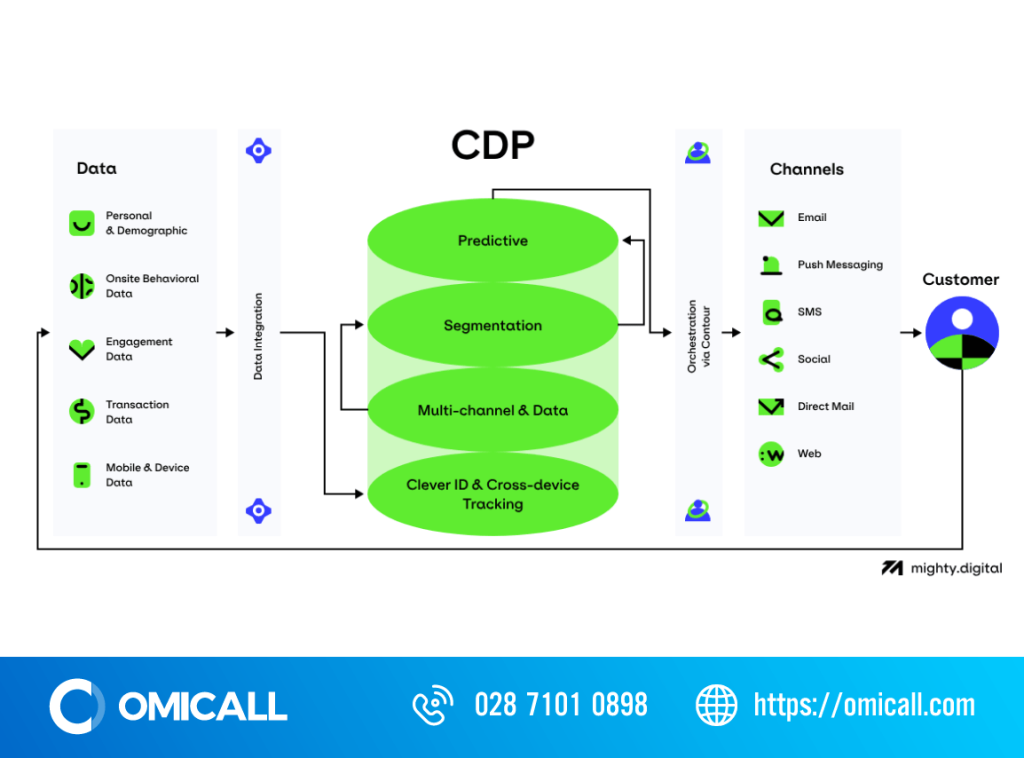
Key benefits of CDP
Deeper customer analysis
Customer analytics involves understanding customer behavior throughout the buying journey, helping to make business decisions related to marketing, product development, sales, and more.
There are four main components to customer analysis:
- Collect data;
- Sort the data;
- Data storage;
- Data analysis.
When you use a CDP to combine all of the above components, you’ll have a powerful platform for customer analytics. And, with the right customer analytics system, you can significantly improve customer loyalty and retention.
Improve data protection and privacy.
After learning how to analyze data to gain insights into customer information, it’s time to ensure data security. Data protection is one of the most important benefits of a Customer Relationship Management (CDP).
Respecting customer data privacy is more important than ever.
Stages of setting up a CDP system
Phase 1: Planning for the CDP
- Define specific goals and project scope: Business objectives, desired customer data throughout the purchase journey;
- Choose specific details to track: Customer information, events, and marketing programs to monitor customers.
Phase 2: Integration
Integrating a Customer Data Program (CDP) into your customer data system helps you identify and analyze customer activity faster. Each customer is assigned a unique ID, allowing for effective customer segmentation. Therefore, campaigns and messages sent to customers are personalized and aligned with their insights.
When integrated, you will have a complete overall picture of your customers. Because behaviors such as clicks, purchases, etc., are clearly tracked, the customer service process will be optimized.
Phase 3: Integration with third-party tools
You can integrate CDP with many other platforms such as:
- Website optimization platform;
- Analysis and prediction platform;
- Advertising platform;
- Mobile marketing platform;
- Intelligent business platform.
Phase 4: CDP Implementation
Integrating CDPs with data analytics platforms will present limitations in customer information management:
- Conflicts arise between different technologies when analyzing data.
- Challenges in multi-channel coordination;
- Customer response is delayed due to an excessive number of user profiles;
- Unidirectional data flow.
Stages of setting up a CDP system
In conclusion
A Customer Relationship Management (CDP) is key to understanding your customers. Once you understand what a CDP is and how to use it correctly, it will provide you with valuable insights into your customers. If you’re ready to take the next step in understanding your customers, a CDP could be the perfect tool for you.

VIHAT TECHNOLOGY Co., Ltd
Headquarters: ViHAT Building – 06 Street No. 16 (Him Lam Residential Area) – Hiep Binh Chanh Ward – Thu Duc District – Ho Chi Minh City
Hanoi Branch: Floor 15, LADECO Building, 266 Doi Can, Ba Dinh, Hanoi
Cambodia Branch: Thida Rath #154 St. 33MC, Sangkat Steung Meanchey, Khan Mean Chey, Phnom Penh

-
 What is Online Marketing? Types of Online Marketing
-
 What is Marketing Automation? Effective Business Applications
-
 Effective Product Marketing – Its Importance in Business
-
 What is a marketing funnel? 5 effective types of marketing funnels.
-
 What is a marketing strategy, and why is it important?
-
 What is churn rate? Ways to reduce customer churn rate.