What are the 7Ps of marketing? The basis for the 7P model in startups.
Reading time: 10 minutes
What is the 7P model in Marketing?
The 7P Marketing Model is one of the theories that aims to enhance the role of marketing in business and organizational management.
This 7P Marketing model comprises three levels: level 1 is the “4Ps,” which are the four fundamental elements of marketing management. These are: the product solutions (or strategies), from idea to product manufacturing, while defining a product as a collection of benefits; the next group being price solutions, from costs to distribution discounts and consumer price; followed by distribution and sales solutions; and finally, product brand promotion solutions (remember, this refers to brand promotion, which includes the product, not product promotion itself).
The foundation of the 7P marketing model.
We call the marketing era the period beginning in the latter half of the 20th century when business models shifted from production-oriented to market-oriented, and later, more precisely, customer-oriented. This shift in business thinking gave rise to a series of new concepts and definitions that helped marketing truly become an effective applied science.
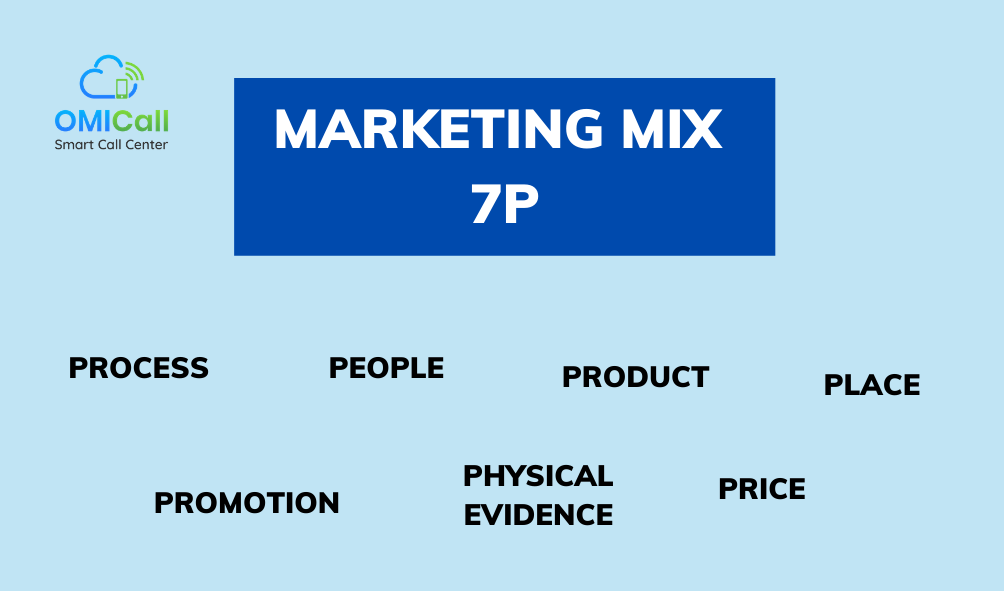
The 7P Marketing Model
In recent decades, successful and sustainable businesses have been marketing- oriented companies , distinct from the other two types of businesses: “businesses that succeed thanks to government policies” and “businesses that succeed based on natural resources.” However, you will surely agree with us that these types of businesses are not the targets we should study, emulate, or pursue in the process of sustainable business development .
Learn about the 3 levels of the 7P marketing model.
This process is a theoretical contrast between the understanding of business management, shifting from Michael Porter’s “5 Forces” model, which centers on the enterprise, to Philip Kotler’s “4Ps” model, which focuses on the “customer.” Macroeconomic calculations are becoming increasingly complex and difficult to understand as consumer needs grow. Alongside this is a shift in psychological research from an individual psychophysiological perspective (Pavlov and Sigmund Freud) to Abraham Maslow’s communal humanistic psychology. While our understanding of human beings from a psychological and needs perspective remains largely mysterious, many community-based behavioral patterns have been documented through statistical analysis. However, the future remains the greatest mystery, and entrepreneurs cannot afford to be complacent. Both Michael Porter and contemporary marketing scholars share the view that the right strategy is to find one’s own “unique path” to meet the diverse and ever-changing needs of humanity. Few people acknowledge marketing at a philosophical level. They believe marketing is cheap tricks and entices people to do things they don’t want to do. We want to warn the community that marketing is an academic discipline elevated to a philosophical level, with brand marketing being its pinnacle. Marketing itself doesn’t define its own mission; rather, people are the driving force that shapes the mission of marketing science (in the broadest sense).
Today, marketing can be applied to any field, as long as it establishes a mission to serve humanity and contribute to human development. Marketing helps to create products or methods to satisfy human needs; moreover, marketing helps people recognize their aspirations (unmet needs) to motivate them to strive for improvement; marketing helps people understand themselves in relation to those around them, and the difference between one product (benefits, value) and another.
Therefore, you should not be surprised when Al Ries (a renowned American marketing scholar, a successor to Philip Kotler) compares the progress of branding and marketing to Darwin’s theory of evolution in human understanding of the physical world, the exchange relationships between individuals in a community, and the establishment of individual position within that community.
The 7P marketing model
P1. Product
A new and comprehensive definition of marketing for products: a product is a collection of benefits.
This definition applies to all product categories and forms, although defining products by classification is always necessary, but this general definition will encompass marketing in all fields, as long as it establishes a mission to serve people.
According to this definition, we don’t need to separate marketing for products or services, marketing for industry or B2B, and marketing for consumer goods and B2C. When a product is recognized by customers—more specifically, when the concept of Benefit shifts to the concept of Value of the same entity—it begins to form a Brand status based on the value that customers recognize.
P2. Selling price
An expanded definition of the concept of selling price would become the value chain, or more accurately, the cost chain.
For example, in agriculture, this chain begins with basic agricultural products, including input costs such as seeds, land, cultivation, and harvesting. This is followed by processing costs into more refined products, and finally, costs for advertising and distributing the product to consumers. The entire process influences the cost chain, and this is a strategic competitive issue for P2. Price, or cost & pricing, refers to the economic benefits provided to customers and consumers. Furthermore, marketing recognizes a close and mutually reinforcing correlation between P1 and P2 through the concepts of segmentation and positioning. A product positioned for the high-end segment requires higher benefits with higher production and service costs, while a product targeting the mass market needs lower costs to generate profit when sold at a lower price.
P3. Distribution
Elevating the concept of “Place” to simply a place of sale, “Distribution” is now an entire sales system or network that is professionally organized and efficient.
Distribution is about bringing products to customers in the most efficient way, but (this is new) it can also bring customers to products in the most convenient way. This process should be called a two-way distribution strategy. The new definition cannot be without the concept of Distribution Channel, which is the definition of vertical or vertical linkage. Each channel is suitable for a different product positioning; this is the superiority of marketing when it brings together a system of different marketing functions guided by the magical pair of concepts: Segmentation and Positioning, and even more so, multi-product Segmentation & Positioning. Adding to the concept of Distribution is Sales Management, a set of personnel levels according to territory, channel, and function, also including the responsibility of coordinating with the central marketing management force to harmonize Push Force (P.3) and Pull Force (P4).
P4. Promotion
The media often confuses marketing with advertising, recognizing only the responsibility of marketing as advertising and media communication—a very common oversight. Promotion, a progressive mission formed by marketing and often misused by advertising, is criticized by conservative viewpoints who believe it can be deceptive or increase costs. These viewpoints are formed without a grasp of the overall strategy or are based on analyses by inexperienced or biased marketers.
With a brand definition that encompasses the product (unlike the WIPO definition of a brand), Brand Promotion is essentially promoting a product or making a promise to customers in a creative way. This alone requires an assessment related to the ethics and responsibility of the brand or business. The creative element is the most controversial and also the most appealing aspect of marketing.
Finally, promotion, with its management function of generating pull, needs to be closely harmonized with push. The formation of a pull and push structure with the concept of above-line vs. below-the-line marketing is the basis of brand management, different from previous marketing management.
At level 2, we are interested in two groups of solutions that reflect the fundamental spirit of management: the Human element (P5) and the System element (P6).
P5. Human beings
Human resource strategies in every company need to be viewed from a marketing perspective. Increasingly, there are more and more people-oriented marketing methods.
Public relations (PR) was utilized extensively from the early years of operation, separated into external PR and internal PR.
External PR aims to build and maintain relationships and customer relationship management (CRM) systems with distributors, the press, sports federations, and media owners.
Internal PR aims to care for each individual employee and their family at all levels of the company. The company has policies to reward and support employees and their families based on their contributions; long-serving employees are rewarded according to their seniority. In particular, the annual Family Day for all employees is organized in a very impressive way, creating a warm and friendly atmosphere… all of which fosters pride among employees and their families in the eyes of those around them.
According to the ” 7P ” system, this group of solutions falls under category P5 (People); and in brand marketing terms, each individual and family of employees is also “labeled” with the overall brand of the business as well as the product brands they are striving to build every day, everywhere, at all times.
P6. Process
In general, this includes system processes, or professionalism. Developing businesses always place management processes (typically ISO:9001) as the foundation for institutionalizing the work system, helping to legalize individual responsibility, or more accurately, “transparentizing” the roles and scope of responsibility of each person so that individuals clearly see their duties and authority within a management team. However, the application of standard management systems (according to ISO) in some businesses with high intellectual content, high service output, or a high degree of creativity does not seem to prove effective.
The 7P Marketing Model explains this phenomenon with a very basic argument: viewing the business organization as a product in which employees benefit from two groups of advantages (or values): rational and emotional. If a business has a management system (reflected in the final product it creates) that is more rational, then the application of ISO (classic) processes will be more effective; conversely, if the business management system is more focused on producing emotional products (services, arts and culture, media, etc.), then the application of classic management processes needs to be combined with measures to stimulate creativity and expand the criteria for evaluating work performance (i.e., the products produced) more flexibly so that employees (intellectual workers) do not feel constrained and perceive the management’s expertise, thus attracting them to work.
In other words, can a classic ISO process manage the creative (production) process of a musical work? This is one of the typical challenges for standardized management processes based on purely rational thinking, which modern marketing management models can overcome, with the “7Ps” being a prime example.
P7. Philosophy
At level 3, we explore the role of ideology, philosophy, and culture within an organization, or more specifically, within a business. Solutions at this level are reflected in the mission or vision of the business and brand; the culture, behavioral habits, and value standards within the business, as well as the brand’s behavior towards the community; and the organization’s ideology, vision, and values must be effectively communicated to all stakeholders and the community, including customers, consumers, partners, their families, and, more broadly, society as a whole.
In sustainable development strategies, the 7P model is increasingly proving its effectiveness.
OMICall provides virtual call center services for businesses . Contact us so we can help your business establish its business prestige by choosing a smart virtual call center for your company.
VIHAT TECHNOLOGY Co., Ltd
Headquarters: ViHAT Building – 06 Street No. 16 (Him Lam Residential Area) – Hiep Binh Chanh Ward – Thu Duc District – Ho Chi Minh City
Hanoi Branch: Floor 15, LADECO Building, 266 Doi Can, Ba Dinh, Hanoi
Cambodia Branch: Thida Rath #154 St. 33MC, Sangkat Steung Meanchey, Khan Mean Chey, Phnom Penh

-
 What is Online Marketing? Types of Online Marketing
-
 What is Marketing Automation? Effective Business Applications
-
 Effective Product Marketing – Its Importance in Business
-
 What is a marketing funnel? 5 effective types of marketing funnels.
-
 What is a marketing strategy, and why is it important?
-
 What is churn rate? Ways to reduce customer churn rate.