
Call Center Services: 3 Models, Costs & Pre-Signing SLA Checklist (2026)
Reading time: 5 minutes
“Hiring a call center service” can mean two very different things: hiring an entire team of people to answer calls, or renting a technology platform for your team to operate independently. Choosing the wrong model can lead to wasted budget or loss of quality control. This article compares three models, breaks down costs, and provides an SLA checklist before signing a contract.
What is a call center service? It’s a service that provides businesses with the capacity to handle customer care and sales over the phone—including call center infrastructure, operational processes, and (depending on the model) a team of call center personnel. Businesses can outsource this service entirely (BPO), lease a platform to operate it themselves, or combine both.
Quick summary
- 3 models: Full-service BPO (hiring both personnel and staff) — self-operated + platform rental (most common) — hybrid (in-house core, rental during peak season).
- Costs: BPO charges per seat/call; platform charges per user + call charges.
- Choose based on: product complexity, data security requirements, and call volume variability.
- Before signing: Checklist of 6 SLA clauses — uptime, service level, support, quality, security, reporting.
1. What is a call center service?
A modern call center is more than just a “phone booth”—it’s a center for handling customer communication via voice (and often text messages and emails). A complete call center service consists of three layers: infrastructure (switchboard, phone numbers, recording), processes (scripts, routing, QA), and people (agents, supervisors). Different service models depend on which layers you outsource and which you handle yourself.
2. 3 deployment models
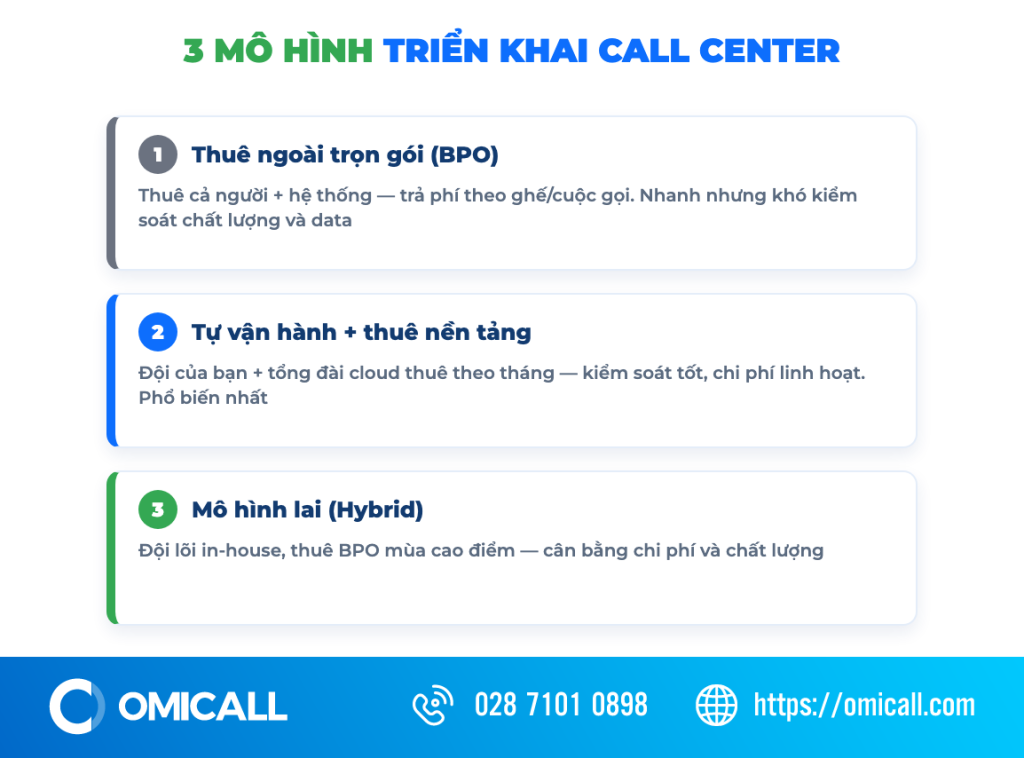
3 call center service models — the most common being self-operated or leased platforms.
Model 1 — Full-service BPO: Partner handles everything from personnel to equipment. Advantages: Fast deployment, no hiring required. Disadvantages: Agents lack in-depth product knowledge, customer data is handled by third parties, costs increase with scale.
Model 2 — Self-operated on a leased platform: your team + cloud-based call center. Advantages: absolute control over quality and data, product knowledge is in-house, flexible costs based on user needs. This is the choice of most Vietnamese businesses today.
Model 3 — Hybrid: an in-house core team handles complex tasks, while BPO hires for simpler workloads or peak seasons — requires a common platform so that data from both sides remains consistent.
3. Which model should you choose for your problem?
| Your problem | Suitable model |
|---|---|
| This is a complex product and requires in-depth consultation. | Self-operated — the agent must understand the product. |
| Sensitive customer data (financial, medical) | Self-operated — absolute data control |
| Short campaign, high volume | BPO or seasonal hybrid |
| Small starting budget | Self-managed with 2-3 people on a cloud platform. |
4. Break down the costs of each model.
- BPO: fees are charged per seat (agent/month) or per call/minute processed; often includes an initial setup fee. Ask carefully about: training fees when changing scenarios, and fees for customized reporting.
- Self-operating platform: user/monthly package + number fee + call charges. Add to your team’s salaries — but in return, the knowledge and data remain with the company.
- Break-even point based on experience: a stable team of 5 or more people, and year-round calls, means self-operation is almost always cheaper than BPO over 12 months.
5. Checklist of 6 SLA clauses
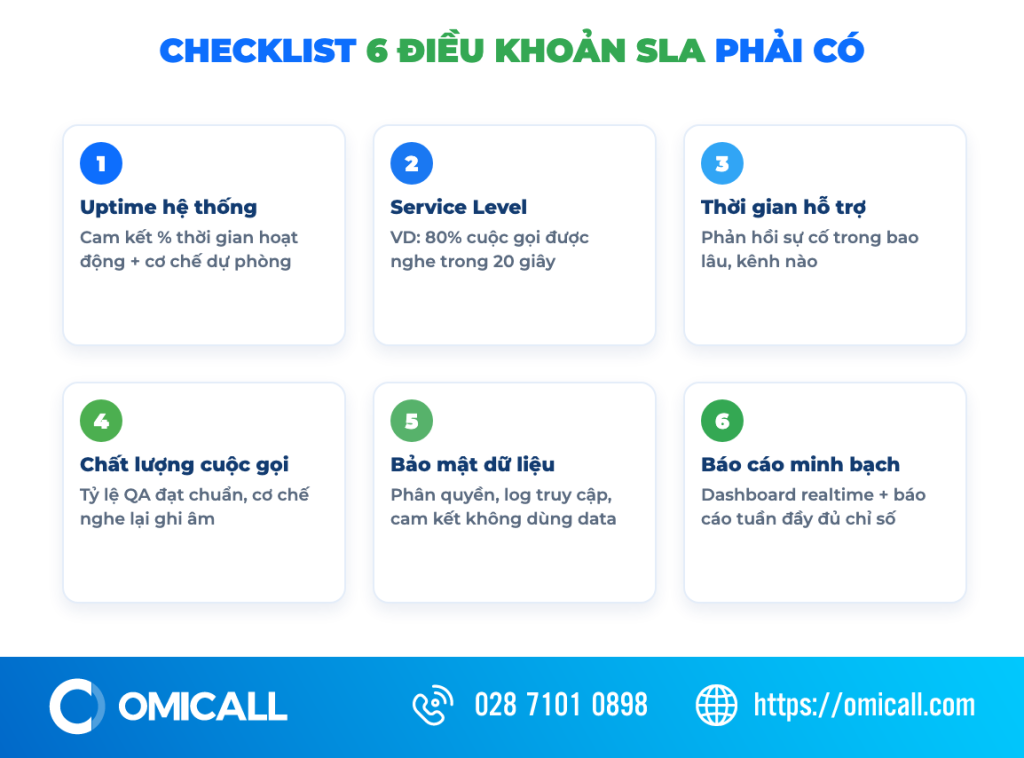
6 mandatory SLA clause groups in service contracts
Regardless of the chosen model, the contract must include all six of the above clauses — especially data security (with BPO: commitment not to use data, access logs, penalty clauses) and transparent reporting (real-time dashboard instead of a summary file at the end of the month).
6. Frequently Asked Questions
1. How much does a call center service cost?
BPO charges per seat or per call; self-operated platforms charge per user plus fees. A proper comparison is to calculate the total cost over 12 months based on the same call volume.
2. Should small businesses hire BPO?
Often not necessary — 2–3 staff members on a cloud platform can already run a professional call center at a lower cost and with better customer understanding.
3. Is customer data secure when outsourcing BPO services?
It depends on the contract: requirements regarding confidentiality, access control, access logs, and audit rights. For sensitive data, an in-house model is recommended.
4. Are call centers and switchboards different?
A switchboard is the infrastructure for receiving and responding to calls; a call center is the entire operational system (people + processes + technology) built on that infrastructure.
5. Is it difficult to transition from BPO to self-operation?
No, if you prepare: rent a platform first, run parallel for 1-2 months, and gradually transition in groups of scenarios from simple to complex.
6. Can AI replace agents in call centers yet?
It can replace repetitive tasks (confirmation, appointment reminders, screening) with call bots; complex consultations still require humans — the effective model is AI to filter first, then humans to process later.
7. Conclusion
There’s no single best call center model—only models that fit the problem: BPO for speed and volume, in-house for quality and data, and hybrid for seasonal fluctuations. Whichever path you take, a strong technology platform and tight SLAs are two things that determine your customer experience.
OMICall provides a cloud-based call center platform for self-operating and hybrid models: AI call center, call recording, automated QA, and real-time reporting. Contact us for a consultation on a model tailored to your business needs.
For further information, please contact:
VIHAT TECHNOLOGY Co., Ltd
Headquarters: ViHAT Building – 06 Street No. 16 (Him Lam Residential Area) – Hiep Binh Chanh Ward – Thu Duc District – Ho Chi Minh City
Hanoi Branch: Floor 15, LADECO Building, 266 Doi Can, Ba Dinh, Hanoi
Cambodia Branch: Thida Rath #154 St. 33MC, Sangkat Steung Meanchey, Khan Mean Chey, Phnom Penh

-
 What is TikTok advertising? Advertising policies and how it works.
-
 Exploring Conceptual Selling – Understanding Modern Sales Trends Correctly
-
 What is a KOC? Distinguishing between KOLs and KOCs.
-
 What Are Customer Insights? Revealing How to Effectively Uncover Them
-
 What is Digital Marketing? 10 Effective Forms of Digital Marketing
-
 What is Online Marketing? Types of Online Marketing





