
PBX vs VoIP: 19 Differences You Need to Know
Reading time: 9 minutes
Are you wondering which telephone network is right for your business? Both PBX and VoIP offer useful features. However, there are significant differences in cost and technical maintenance for each solution. In this article, we will analyze these issues in depth and suggest the appropriate choice for each solution for different businesses.
Let’s start with the most basic elements.
What is PBX?
PBX stands for Private Branch Exchange, a telephone system within a business. It connects all desk phones on the same network. The PBX allows your business to make free internal calls and freely transfer calls.
With PBX, a company can have more phones than the number of lines connected. Instead of actual lines, it uses extensions to redirect calls to the business number. Currently, IP PBX telephone networks are emerging, cloud-hosted PBX solutions offered by VoIP providers. This solution retains the features of a PBX without requiring on-site installation.
What is VoIP?
Voice over Internet Protocol (VoIP) is a technology for transmitting voice data over the Internet.
VoIP phones record your voice and convert it into data. The system compresses these files in real time and turns them into data packets. These packets then travel to your VoIP provider, where they are converted and connected to the target phone.
It sounds like a long and slow process, but data travels at the speed of light. There is no difference in speed between analog and VoIP calls.
The difference between IP PBX and VoIP
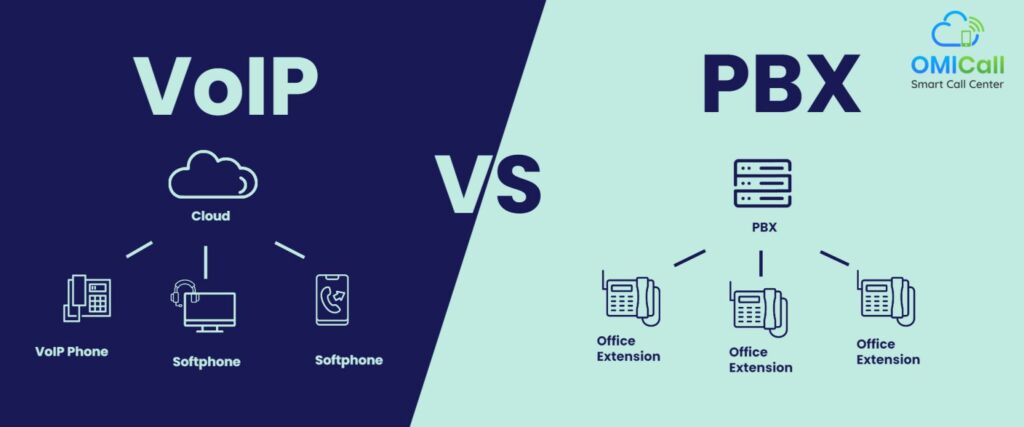
Legacy PBX systems used similar switchboards to the public switched telephone network (PSTN). Today, most PBX systems use the digital network protocol (IP) for internal calls. These newer systems are also known as IP PBXs.
Some IP PBXs convert digital signals on-site and use telephone lines directly connected to the PSTN.
VoIP is an approach to transferring calls over the Internet. With VoIP, phones send digital call data to the VoIP provider. Data centers then translate it into analog signals and send them to the PSTN.
With a VoIP PBX, your provider holds all the hardware and operates it. While with an IP PBX, you must have an on-site IT team to operate your hardware.
Do you need a PBX to deploy VoIP?
Your business does not need a PBX system to use VoIP effectively. The only requirements for VoIP are an internet connection and IP phones. Your VoIP provider can also offer you most PBX features without needing on-premise PBX hardware.
If you already have a PBX in your office, you can deploy a cloud-based PBX to use VoIP to handle all your company calls.
PBX and VoIP: 19 Differences
There are advantages and disadvantages to both PBX and VoIP. Below, we outline 19 key differences to help you choose the right system for your company’s call center.
Investment Costs
Installing an on-premise PBX is a major project and requires a significant upfront investment. It requires a continuous power supply, an expensive router, a VoIP gateway, software, and other hardware. That’s not to mention the cost of phones and headsets.
With VoIP, the main hardware you need to invest in is IP phones. You can even use your computer’s USB headset to cut down on upfront costs.
Operating Costs
VoIP providers typically follow a subscription model. With OMICall, if your company has more than 30 employees, the cost is 30,000 VND per user per month. Even our more basic packages offer PBX features like call routing and forwarding.
The operating costs of an on-premise PBX depend on your setup. These may include software licenses, maintenance and service fees, update fees, and your phone bill. The cost of a business’s landline phone alone can be up to 60% more expensive than VoIP.
Call Quality
Two main factors affect call quality: hardware and signal strength. On-premise PBXs have an advantage in signal strength compared to VoIP. However, current internet technology has made major breakthroughs in maintaining signal stability. Therefore, there is no significant difference in this aspect.
Regarding hardware, the call quality of an on-premise PBX depends on your routers, switches, and VoIP gateway. While a VoIP PBX depends on your service provider.
Scaleability
With a VoIP PBX, you order more IP phones, add users to your package, and that’s it. You may need to upgrade your broadband internet package or add a switch. Multiple branches or offices can use the same VoIP package.
With a PBX, it’s not that simple. You have to add auxiliary phone lines and install new hardware. For new offices, you need to install a completely new PBX system.
Reliability
The reliability of VoIP depends on your provider. OMICall is a reputable provider of virtual PBX systems, trusted by thousands of large and small businesses nationwide. We have also received thousands of positive reviews on numerous industry websites.
PBX systems offer high reliability. The only factor is whether your IT department has the expertise to operate them. Otherwise, troubleshooting problems can be time-consuming and disrupt communication.
Flexibility
With VoIP, you can work anywhere on any device as long as there is an internet connection. Conversely, a PBX system can only operate at the office where the system is installed.
Security
The security of a VoIP PBX depends on the cybersecurity team of the service provider. Choosing a reputable provider is crucial in this regard.
On-site PBXs are not connected to the internet, so they are less susceptible to hacking.
Domestic Long-Distance Calls
VoIP doesn’t differentiate call rates between long-distance and internal calls. With a PBX, you might have to pay extra for long-distance calls.
International Calls
Telephone companies charge unreasonable per-minute rates for international calls. If your PBX uses a landline, you pay the regular telephone company the charges.
But with VoIP, international call rates tend to be much lower. You can also call other VoIP phones in the same package for free – anywhere in the world.
Unexpected Outages
Analog telephone lines are not dependent on the power grid. But PBX installations, with their servers and internal ports, depend on electricity.
Similarly, VoIP connects to the PSTN via the internet, and the modem requires power to operate. Therefore, both PBX and VoIP will go offline if there’s a power outage.
However, virtual PBXs support softphones on smartphones for situations requiring communication during a power outage.
Voicemail Feature
Nobody wants to call a voicemail number and slowly listen through each message. Both PBX and VoIP offer advanced features like voicemail to email.
Cross-Platform Communication
With traditional analog phones, communication is limited to calls and texts. PBX and VoIP support messaging and video calls; however, the difference is that VoIP can send unlimited data over office distances.
Internet Technology
Traditional trunk lines for PBXs use PRI, which is an older technology. It typically runs on a separate network from your LAN and can be time-consuming and expensive to maintain. VoIP, on the other hand, can utilize your existing Ethernet network infrastructure for connectivity. VoIP calls only require around 100 kbps of bandwidth per line. This is a very small bandwidth compared to modern internet infrastructure.
End-Telephone Equipment
A traditional PBX can only work with phones of the same technology. Because other solutions have become more common, compatibility issues often arise.
With a VoIP system, you have more options. You can use IP phones or regular desk phones with an adapter. Businesses can even use mobile devices or softphone applications on their computers.
Customizing the Telephone System
Installing an IP PBX can be customized, but it’s a complex process that tends to require new hardware and technical support.
With VoIP, you can often customize your package to get the functionality you need without making any hardware changes. OMICall customers can easily manage everything through the online dashboard. From routing editing to call queue management and the entire call center, it’s all there.
System Upgrades
Just like scaling and customization, upgrading a PBX system can be a challenge. At the very least, you need new hardware and technicians experienced in PBX. You might even need a team of developers, depending on your goals. With VoIP, your provider will handle everything.
Mobile Phone Compatibility
You can’t use a smartphone with a traditional PBX. With IP PBX, there are very few compatible applications.
With VoIP, smartphones are an added option for your PBX. This allows employees to make and answer calls using their own numbers. Customers won’t even know they’re outside the office.
Integration of Support Tools
IP phones make it easy to add additional tools and accessories to your system. Through open standards and common interfaces like USB and Bluetooth, you can easily expand the phone with headsets.
For telesales/customer service staff, integrating CRM software into the PBX is essential. This tool will help them interact with customers better.
Business Scale
Traditional PBX systems are suitable for large office buildings with hundreds of employees. Installing an IP PBX is suitable for medium-sized businesses. It’s worth noting that they need sufficient IT staff and a reasonable technology budget to deploy and maintain the system. VoIP PBX systems are suitable for businesses of all sizes, from large enterprises and small and medium-sized businesses to startups.
PBX or VoIP for your business?
PBX and VoIP share many similar features and benefits. The real differences lie in scalability, cost, maintenance, and data storage and retrieval between branch offices. Based on the above evaluations, you should now be able to choose the solution that best suits your business. If you need any further advice, please contact us for the best support.
VIHAT TECHNOLOGY Co., Ltd
Headquarters: ViHAT Building – 06 Street No. 16 (Him Lam Residential Area) – Hiep Binh Chanh Ward – Thu Duc District – Ho Chi Minh City
Hanoi Branch: Floor 15, LADECO Building, 266 Doi Can, Ba Dinh, Hanoi
Cambodia Branch: Thida Rath #154 St. 33MC, Sangkat Steung Meanchey, Khan Mean Chey, Phnom Penh

-
 What is TikTok advertising? Advertising policies and how it works.
-
 Exploring Conceptual Selling – Understanding Modern Sales Trends Correctly
-
 What is a KOC? Distinguishing between KOLs and KOCs.
-
 What Are Customer Insights? Revealing How to Effectively Uncover Them
-
 What is Digital Marketing? 10 Effective Forms of Digital Marketing
-
 What is Online Marketing? Types of Online Marketing





