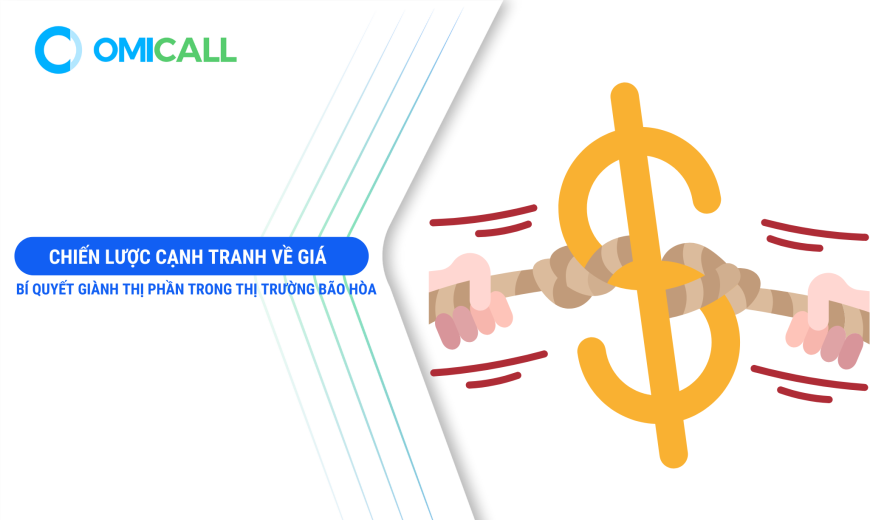
Price competition strategy – The secret to gaining market share in a saturated market.
Reading Time: 6 minutes
In a highly competitive environment, businesses must consider and develop competitive pricing strategies to expand their market share. This article will delve into price competition strategies, revealing secrets to help businesses bring their products or services to the top at a reasonable cost.
What is a Price Competition Strategy?
A price competition strategy is a pricing strategy based on comparing the price of a product or service with that of competitors. This strategy is often applied in saturated markets where businesses compete directly on price.
Types of Price Competition Strategies
There are many different types of strategies, depending on the specific goals and situation of the business. Some common types of price competition include:
Low Pricing Strategy
This is the most common strategy, in which a business prices its products or services lower than its competitors. This strategy can help businesses attract price-sensitive customers, but it may lead to reduced profits.
High Pricing Strategy
This is a strategy of pricing products or services higher than competitors. This strategy can help businesses achieve higher profits, but it may discourage customers from purchasing the product or service.
Sandwiching Pricing Strategy
This is a strategy of pricing products or services between the highest and lowest prices of competitors. This strategy can help businesses attract customers in multiple segments.
Promotional Pricing Strategy
This is a strategy of pricing products or services at a lower price for a certain period to attract customers. This strategy can help businesses increase sales, but it may affect profits in the short term.
Benefits of Price Competition Strategy
A price competition strategy can bring many benefits to businesses, including:
- Attracting price-sensitive customers: A low-pricing strategy can help businesses attract price-sensitive customers who are concerned about saving costs.
- Increasing sales: A price-competitive strategy can help businesses increase sales, especially in saturated markets.
- Gaining market share: A price-competitive strategy can help businesses gain market share from competitors.

Benefits of a Price-Based Competitive Strategy
Risks of a Price-Based Competitive Strategy
Price competition also carries several risks, including:
- Reduced Profits: A low-pricing strategy can lead to reduced profits, especially if the business cannot control costs.
- Lack of Competitive Advantage: Price-based competition can leave a business without a competitive advantage over competitors with other factors such as product quality, customer service, etc.
- Negative Price Competition: Price competition can lead to negative price competition, where businesses compete by lowering prices, harming all businesses in the industry.
Choosing the Right Price Competition Strategy
To choose the right competition strategy, businesses need to consider the following factors:
Business Objectives
What goals does the business want to achieve when applying a price competition strategy? Does the business want to attract price-sensitive customers, increase sales, or gain market share?
If the business wants to attract price-sensitive customers, a low-price strategy is suitable. This strategy will help the business compete with other competitors on price, thereby attracting customers who need to save costs.
If the business wants to increase sales, a promotional pricing strategy may be a suitable choice. This strategy will help the business increase sales in the short term, but may affect profits.
If the business wants to gain market share, a price-snapback pricing strategy may be suitable. This strategy will help the business attract customers in many different segments, thereby gaining market share from competitors.
Market Competitive Landscape
Is the market saturated? What pricing strategies are competitors employing?
If the market is saturated, the business needs to carefully consider its pricing strategy. In this case, the business could choose a “sandwich pricing” strategy to attract customers in various segments, or a promotional pricing strategy to increase sales in the short term.
If the market is not yet saturated, the business could choose a low-price strategy to attract price-sensitive customers, or a high-price strategy to position its product or service in the premium segment.
Production Costs
Can the business’s production costs support its chosen strategy?
If the business’s production costs are high, it should carefully consider a low-price strategy. This strategy could lead to reduced profits, especially if the business cannot control costs. The above are some important factors that businesses need to consider when choosing a suitable strategy. Businesses need to carefully research these factors to make the right decision, helping them achieve their business goals.

Choosing the Right Price Competition Strategy
In Conclusion
A price competition strategy is not simply about lowering prices to attract customers, but rather a complex process requiring a deep understanding of the market, competitors, and the business itself. By applying the details and insights mentioned, businesses can build a strong strategy that helps them reach the top and retain customers sustainably.
VIHAT TECHNOLOGY Co., Ltd
Headquarters: ViHAT Building – 06 Street No. 16 (Him Lam Residential Area) – Hiep Binh Chanh Ward – Thu Duc District – Ho Chi Minh City
Hanoi Branch: Floor 15, LADECO Building, 266 Doi Can, Ba Dinh, Hanoi
Cambodia Branch: Thida Rath #154 St. 33MC, Sangkat Steung Meanchey, Khan Mean Chey, Phnom Penh

-
 What is Online Marketing? Types of Online Marketing
-
 What is Marketing Automation? Effective Business Applications
-
 Effective Product Marketing – Its Importance in Business
-
 What is a marketing funnel? 5 effective types of marketing funnels.
-
 What is a marketing strategy, and why is it important?
-
 What is churn rate? Ways to reduce customer churn rate.