

The Most Practical and Impressive Ways to Apply AI in Marketing
Reading time: 7 minutes
The application of AI in marketing is ushering in a new era for the advertising and marketing industries. From analyzing customer data to automating complex processes, AI not only saves time and costs but also delivers significant results.
Why do businesses use AI in marketing?
So, for what purposes do businesses apply AI to marketing, and what results does it yield?
Customer data analysis
AI has the capability to process and analyze vast amounts of data from diverse sources such as social media, websites, and email. Businesses can leverage this data to gain a deeper understanding of customer behavior and preferences, thereby optimizing their marketing strategies.
A prime example is Natural Language Processing (NLP) technology, which analyzes customer feedback and comments, helping marketers gain profound insights into consumer sentiment and desires.
Customer care and experience personalization
AI utilizes chatbots to answer inquiries and provide customer support 24/7, helping businesses save time and reduce costs.
AI can also analyze data from purchase history and customer interactions to offer product recommendations tailored to individual needs. This enhances the effectiveness of marketing campaigns and boosts customer satisfaction.
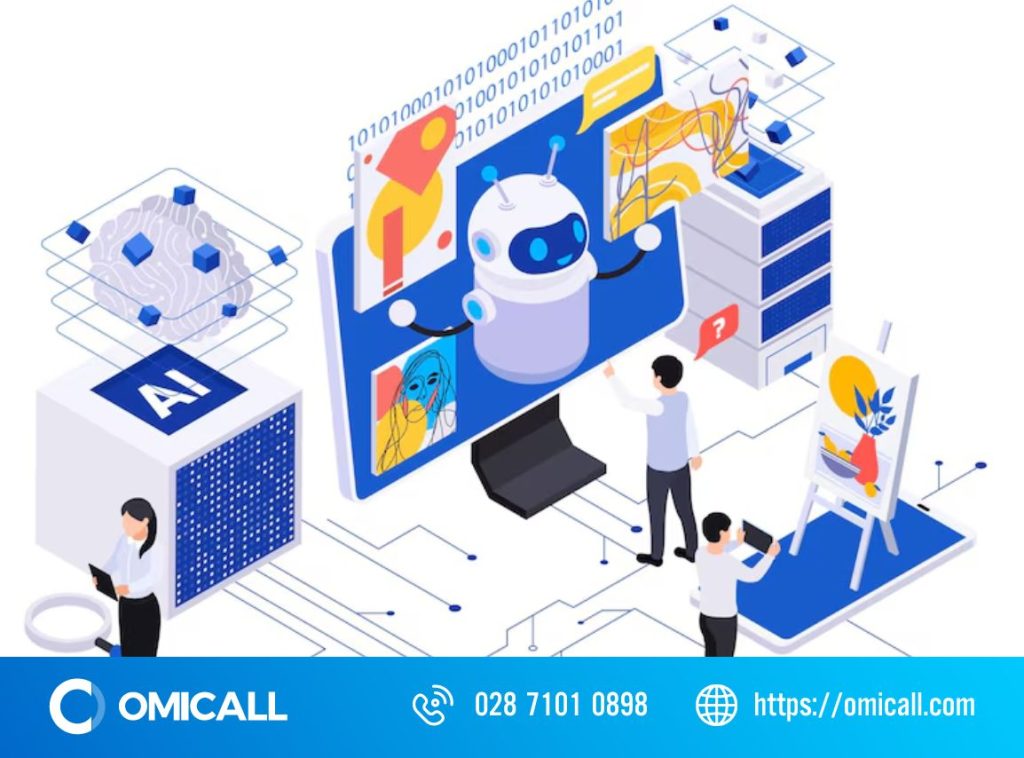
How do businesses use AI in marketing?
Automating marketing campaigns
AI helps automate marketing activities—such as email sending, ad management, and customer interaction via chatbots—thereby saving time and reducing costs.
Chatbots integrated with Mini-CRM systems serve as powerful tools for managing customer information and automating interactions, ultimately enhancing customer service efficiency. Customers receive support anytime, anywhere, with their inquiries addressed promptly.
Optimizing advertising campaigns
By analyzing performance and adjusting strategies based on key metrics—such as click-through rate (CTR), conversion rate, and ROI (Return on Investment)—AI helps businesses optimize advertising campaigns, improving effectiveness and cutting costs.
Forecasting market trends
AI utilizes predictive models to analyze market data, enabling forecasts regarding future consumer trends and customer behavior.
Managing marketing content
Businesses can use AI tools to automatically generate content based on current data and trends, saving time while ensuring the content remains fresh and engaging.
Managing online reputation
AI analyzes posts, comments, and reviews across social media platforms and websites to monitor and manage a business’s online reputation. This enables the implementation of reputation-improvement measures and rapid crisis management.

Vietnam’s leading AI-powered multi-channel virtual call center solution
AI application strategies in marketing across various enterprises
Many businesses have successfully implemented AI, achieving positive results and significantly improving the customer experience.
Coca-Cola – Creating creative content and personalization
Coca-Cola utilizes AI to generate creative content and personalize the customer experience. The company employs machine learning technology to analyze customer data and devise effective marketing strategies.
Coca-Cola creates personalized advertising videos for individual customers based on data regarding their preferences and purchasing behavior. Additionally, the company uses AI to analyze social media posts and comments to gain deeper insights into customer sentiment and interests, thereby tailoring marketing content more effectively.
Netflix – Content recommendations
Netflix’s AI system analyzes user viewing data to provide tailored recommendations.
The AI analyzes factors such as genre, viewing duration, and user ratings to suggest movies and shows that the user is likely to enjoy. This approach increases viewing frequency on the platform and enhances user retention.
AI Application Strategies in Marketing: Examples from Leading Companies
Amazon – Personalizing the Shopping Experience
Amazon’s recommendation system uses AI to analyze customer purchasing behavior and provide tailored product suggestions. This drives sales and enhances the overall shopping experience.
Amazon also employs AI to optimize inventory management, forecast product demand, and adjust stock levels accordingly, thereby reducing costs and improving operational efficiency.
Starbucks – Optimizing the Loyalty Program
The Starbucks mobile app uses AI to analyze customer purchasing habits and send personalized offers based on that data. This strategy not only boosts sales but also strengthens customer loyalty.
Sephora – Virtual Assistants and Augmented Reality
Sephora utilizes virtual assistants to enable customers to try on makeup products online. AI analyzes images of the customer’s face and applies makeup products, allowing them to see the results instantly.
Unilever – Analyzing Customer Sentiment
Unilever uses AI to analyze social media conversations and trends to gain deeper insights into customer sentiment and consumption patterns. This data helps the company adjust marketing campaigns and develop new products that align with market needs.
How Can Businesses Apply AI in Marketing?
There is currently a wide range of tools and applications available to help businesses integrate artificial intelligence into their marketing activities.
The Most Practical and Impressive AI Applications in Marketing
- Utilize AI tools such as Google Analytics or IBM Watson to collect and analyze customer data from various sources, including social media, email, and websites.
- Leverage AI models like OpenAI GPT-3 to rapidly generate compelling content—ranging from articles and videos to creative ideas—based on the data provided.
- Employ AI platforms like Dynamic Yield or Adobe Target to analyze customer behavior and preferences, enabling the creation of more personalized marketing campaigns.
- Use tools such as HubSpot or Marketo to automate email distribution, manage advertising, and facilitate customer interactions via chatbots.
- Utilize tools like SEMrush or HubSpot Analytics to track and evaluate marketing campaign performance, helping businesses adjust their strategies in a timely manner.
- Apply AI within advertising platforms like Google Ads or Facebook Ads to automatically optimize content, audience targeting, and budgets based on real-time performance data.
- Use forecasting tools such as SAS Forecasting or H2O.ai to analyze historical data and predict market trends, facilitating timely and accurate decision-making.
Conclusion
OMICall is a pioneering platform in integrating AI into marketing and customer care solutions, featuring a smart call center system that incorporates multiple communication channels and advanced automation tools. Explore OMICall’s solutions today to leverage AI in your marketing efforts—enhancing the customer experience, optimizing costs, and boosting revenue.
For more information, please contact:
VIHAT TECHNOLOGY Co., Ltd
Headquarters: ViHAT Building – 06 Street No. 16 (Him Lam Residential Area) – Hiep Binh Chanh Ward – Thu Duc District – Ho Chi Minh City
Hanoi Branch: Floor 15, LADECO Building, 266 Doi Can, Ba Dinh, Hanoi
Cambodia Branch: Thida Rath #154 St. 33MC, Sangkat Steung Meanchey, Khan Mean Chey, Phnom Penh

-
 What is TikTok advertising? Advertising policies and how it works.
-
 Exploring Conceptual Selling – Understanding Modern Sales Trends Correctly
-
 What is a KOC? Distinguishing between KOLs and KOCs.
-
 What Are Customer Insights? Revealing How to Effectively Uncover Them
-
 What is Digital Marketing? 10 Effective Forms of Digital Marketing
-
 What is Online Marketing? Types of Online Marketing





