What Are IP and SIP? Distinguish Between SIP, VoIP, and IP PBX in Just 5 Minutes
Reading time: 9 minutes
When searching for a PBX solution, almost everyone encounters a jumble of abbreviations: IP SIP, VoIP, SIP Trunking, IP PBX, IP Phone. Providers use them interchangeably, and buyers are often unclear about what they are comparing. This article separates each concept, clarifies which layer they belong to in a voice system, and helps you understand price quotes without confusion.
What is IP SIP? This term combines two separate concepts. IP (Internet Protocol) is the underlying protocol that allows data to travel over the internet—including voice data packets. SIP (Session Initiation Protocol) is the protocol responsible for establishing, maintaining, and terminating a communication session, such as a voice or video call. In short: IP handles the transmission, SIP handles answering and hanging up. Together, they create VoIP—a service for making calls over the internet.
Quick summary
- IP: Data transport infrastructure. Not just for voice — web, email, and video all run on IP.
- SIP: Signaling Protocol. Determines who calls whom, rings, answers, transfers calls, and hangs up.
- VoIP: Internet calling service — the result of using SIP over an IP network.
- SIP Trunking: Virtual trunk lines replace physical telephone lines, connecting internal PBXs to the public telecommunications network.
- IP PBX: An internal telephone system running on IP technology, replacing traditional wired PBX systems.
- IP Phone: A landline phone that uses a network cable instead of a telephone line.
- What businesses need to know: You’re buying a VoIP service . SIP and IP are the underlying technologies—important when evaluating integration capabilities and voice quality.
1. What is IP in a voice system?
IP—short for Internet Protocol —is a set of rules that govern how data is divided into packets, addressed, and transported between devices on a network. Everything you do on the internet goes through IP: opening websites, sending emails, watching videos.
When applied to voice communication, your voice is digitized, broken down into small data packets, assigned a destination address, and then sent over the internet. At the other end, these packets are reassembled and played through a speaker. The entire process takes only a few tens of milliseconds.
The important point to remember: IP only handles transport . It doesn’t know whether the data packet is carrying voice or video, nor does it know when the call started or ended. That’s SIP’s job.
2. What is SIP and what is its function?
SIP — Session Initiation Protocol — is a signaling protocol responsible for managing multimedia communication sessions: voice calls, video calls, and multi-party conferencing. It is an open standard described in IETF RFC 3261 , so devices from different manufacturers can work with each other.
You can think of SIP as a call center receptionist: it sends an invitation, “A wants to speak with B,” waits for B to accept, agrees on which audio standard each party will use, maintains the session throughout the call, and closes the session when one party hangs up. Familiar voice calling services like Skype or Facebook Messenger are based on this principle.
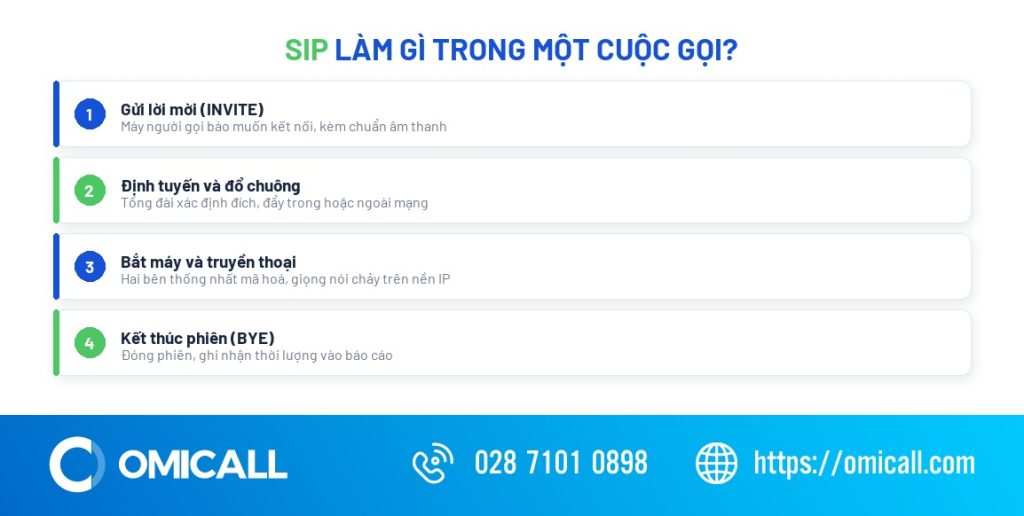
What does SIP do during a call?
One reason SIP is so popular is that it’s an open, internationally standardized protocol . Devices and software from many different manufacturers can communicate with each other, as long as they all comply with SIP. This is why businesses aren’t locked into a single provider like they were in the days of analog PBXs.
3. Differentiate between SIP IP, VoIP, and SIP Trunking
These four concepts are at four different levels. Confusion arises because in business conversations, they are often used interchangeably.
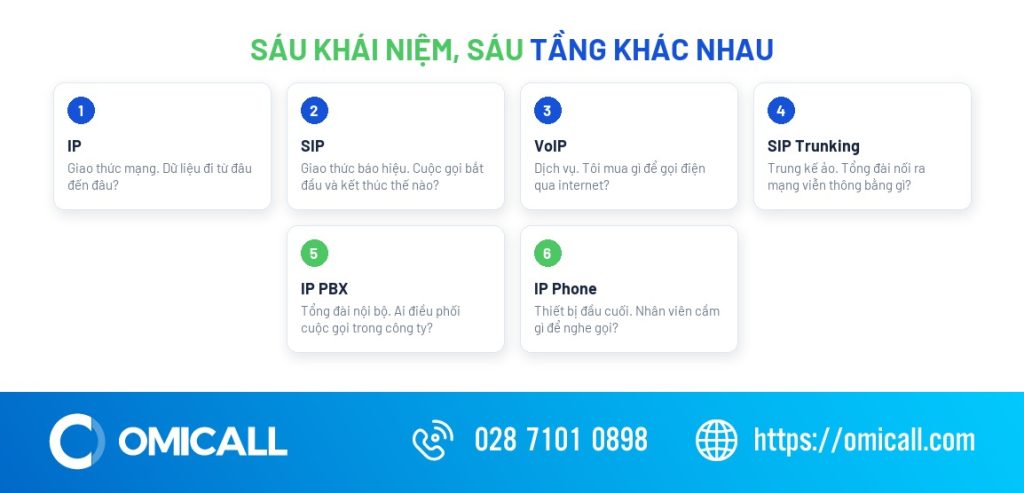
Six concepts, six different levels
| Terminology | Nature | Answer the question |
|---|---|---|
| IP | Network protocol | Where does the data go from and to? |
| SIP | Signaling protocol | How did the call start and end? |
| VoIP | Service | What do I need to buy to make calls over the internet? |
| SIP Trunking | Virtual trunk line | What does my switchboard use to connect to the telecommunications network? |
| IP PBX | Internal telephone exchange | Who handles calls within the company? |
| IP Phone | Terminal | What does the employee hold while taking calls? |
Đó là toàn bộ khác biệt giữa các thành phần trong một hệ thống IP SIP. Một cách That’s the whole difference between the components in an IP SIP system. A simple way to remember: IP is the road, SIP is the traffic law, VoIP is the ride, SIP Trunking is the highway exit, IP PBX is the dispatch station, and IP Phone is the vehicle.
4. How does a SIP call work?
When an employee dials a customer’s number, the sequence of events unfolds in four stages:
Phase 1 — Sending an invitation. The caller’s device sends a SIP INVITE message to the exchange, along with information about the audio standard it supports.
Phase 2 — Routing and Ringing. The PBX identifies the destination. If it’s an internal number, the call goes directly within the company network. If it’s an external number, the call is routed through SIP Trunking to the public telecommunications network. The destination phone rings.
Phase 3 — Picking up and transmitting voice. When the other party picks up the phone, both sides agree on an audio encoding standard, and then the voice begins to flow as data packets over the IP network.
Phase 4 — Session End. One party hangs up, the SIP BYE message is sent, the session closes, and the system records the call duration in a report.
With a modern virtual call center, phases 2 and 3 add even more layers of processing: enabling automatic call recording, displaying customer information on employee screens, and recording calls in customer profiles on the management system.
5. Why are businesses switching to SIP IP PBX systems?
- No physical infrastructure is required. SIP runs on IP, so there’s no need to run separate telephone lines, and no hardware maintenance costs for the PBX system.
- Calls are significantly cheaper. Calls are transmitted over the internet to the nearest destination, so most of the journey is free of long-distance telecommunication charges.
- Expand in hours. Adding 20 employees means adding 20 accounts to the system, with no physical installation required. The number of simultaneous channels is also flexible to meet demand.
- Better disruption resistance. SIP systems can provide redundant routing to a different data center when one point fails—something analog PBXs cannot do.
- Work from anywhere. Employees can log into the app on their computer or phone and make and receive calls using their company number, whether they’re in the office or at home.
6. 4 steps to implement SIP for businesses
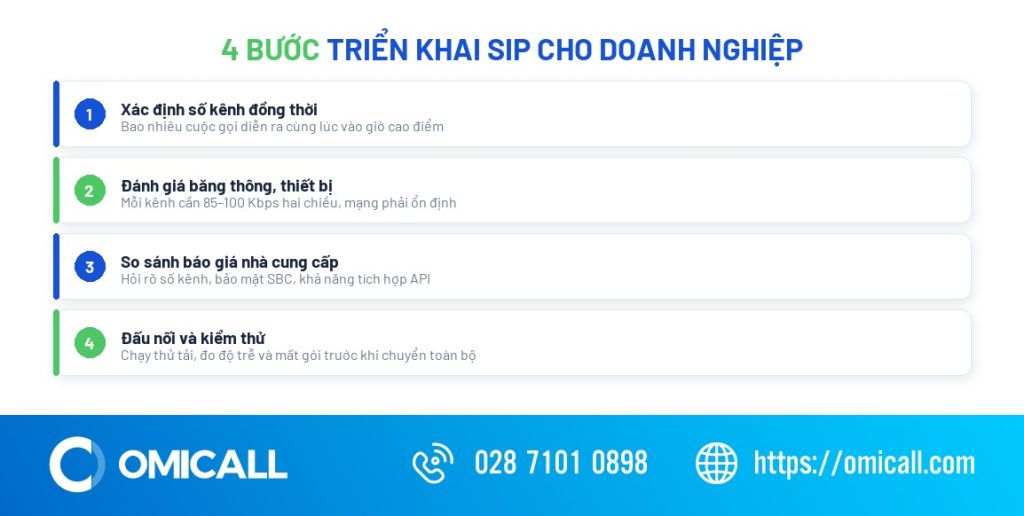
Roadmap to SIP
The most easily overlooked step is assessing bandwidth . Each simultaneous voice channel needs approximately 85–100 Kbps in both directions. A team of 20 people calling at the same time needs a stable connection, not just high speed — latency and packet loss are what ruin voice quality, not the Mbps number on your internet contract.
7. Technical points to check before signing an IP SIP contract.
- Number of simultaneous channels: Ask for clarification on the package’s allowed number of simultaneous calls and the cost of exceeding this limit during peak hours.
- Security: Does the system have a Session Border Controller? This is a layer that blocks attacks and billing fraud — without it, a compromised SIP account could generate bills worth tens of millions of VND.
- Encryption: Are calls encrypted? In the finance and healthcare industries, this is a mandatory requirement, not an option.
- Integration capability: Does the system have an API to connect with existing customer management software? If calls are not recorded in the customer profile, the data value is virtually zero.
- Retain the existing phone number: Confirm that the business will retain its current phone number when switching to a new provider.
- Contingency plan: If the office internet is down, will calls automatically be transferred to employees’ mobile phones?
Tip for reading price quotes: If the provider only quotes “per user/month” without specifying the number of simultaneous channels, ask for clarification. Two packages with the same price but different numbers of channels will offer completely different experiences during peak hours.
8. Frequently Asked Questions
What are IP and SIP, and how do these two concepts differ?
IP is a network data transport protocol. SIP is a signaling protocol that determines how a call begins, is forwarded, and terminates. SIP runs on top of IP; it does not replace IP.
Are SIP and VoIP the same thing?
No. VoIP is a general term for internet-based calling services. SIP is the most common protocol for implementing VoIP, but it’s not the only one.
Do I need to buy IP phones when using SIP?
Not required. Employees can use softphone software on their computers or mobile phone applications. IP phones are suitable for fixed locations such as reception desks or call center desks.
What is SIP Trunking?
It’s a virtual trunk line that connects a company’s internal PBX to the public telecommunications network via the internet, replacing traditional physical telephone lines.
Is the quality of SIP calls stable?
Yes, if the connection has sufficient bandwidth and low latency. The deciding factor is network stability, not download speed. Voice streams should be separated and bandwidth prioritized for them.
Should small businesses use SIP?
Yes. Small businesses benefit the most because they don’t have to invest in PBX hardware, pay based on the actual number of users, and can scale flexibly as their team grows.
9. Conclusion
IP, SIP, and VoIP are not interchangeable options—they are three layers of the same system. Businesses purchase VoIP services; SIP is the protocol that makes the service work; IP is the underlying infrastructure. Understanding the proper place of each concept helps you get more accurate quotes and ask the right questions of the provider: how many simultaneous channels, what is the security like, and what systems are compatible?
OMICall provides a SIP-based virtual PBX with full enterprise features: IVR greetings, call distribution, automatic recording, free internal calls between branches, and built-in customer management tools. Employees can make and receive calls using company numbers on IP phones, computers, or mobile phones. Sign up for a free trial to test voice quality on your own network.
For further information, please contact:
VIHAT TECHNOLOGY Co., Ltd
Headquarters: ViHAT Building – 06 Street No. 16 (Him Lam Residential Area) – Hiep Binh Chanh Ward – Thu Duc District – Ho Chi Minh City
Hanoi Branch: Floor 15, LADECO Building, 266 Doi Can, Ba Dinh, Hanoi
Cambodia Branch: Thida Rath #154 St. 33MC, Sangkat Steung Meanchey, Khan Mean Chey, Phnom Penh

-
 What is Online Marketing? Types of Online Marketing
-
 What is Marketing Automation? Effective Business Applications
-
 Effective Product Marketing – Its Importance in Business
-
 What is a marketing funnel? 5 effective types of marketing funnels.
-
 What is a marketing strategy, and why is it important?
-
 What is churn rate? Ways to reduce customer churn rate.