What is VUCA? Top 4 Leading VUCA Marketing Strategies Worldwide
Reading time: 7 minutes
“What is VUCA?” This is a question many businesses and managers are asking in today’s economic climate. The business environment is constantly changing, demanding adaptation and innovation. In this article, we will delve deeper into the concept of VUCA, VUCA leadership, the meaning of the elements in the VUCA era, as well as the necessary skills to survive in this environment and marketing strategies for businesses to lead in the VUCA world.”
Vietnam’s Leading AI-powered Multi-Channel Virtual Call Center
What is VUCA?
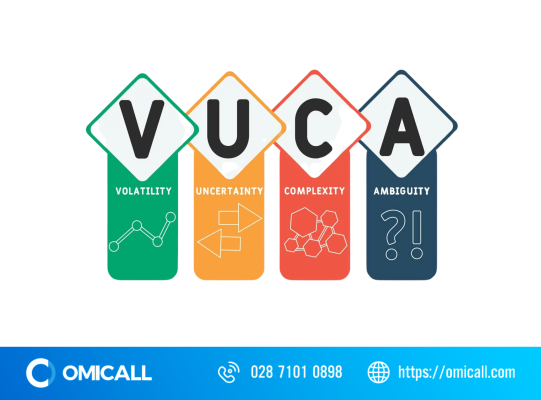
VUCA is an acronym derived from four words: Volatility, Uncertainty, Complexity, and Ambiguity. It’s a common term in business management to describe the modern business environment, which is characterized by volatility and uncertainty.
What is VUCA?
What is the concept of VUCA Leadership?
VUCA Leadership is a leadership style and a value system developed to address the challenges of the modern, volatile, and uncertain business environment, described by the concept of VUCA (Volatility, Uncertainty, Complexity, Ambiguity).
VUCA Leadership encompasses a range of leadership capabilities and characteristics aimed at fostering adaptability and innovation within the organization and ensuring that the business can navigate through uncertainty.
What is the significance of the components in the VUCA era?
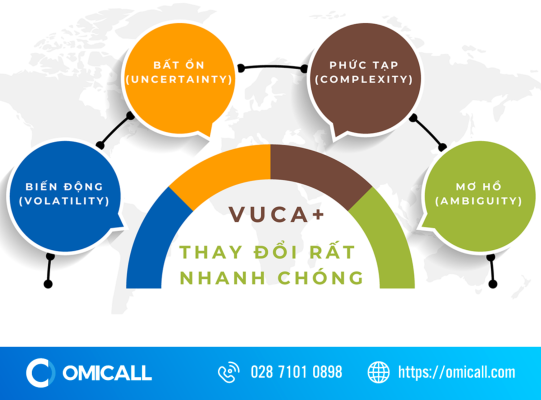
The components of the VUCA era (Volatility, Uncertainty, Complexity, Ambiguity) are crucial in describing and gaining a deeper understanding of the modern business environment. Below is the meaning of each component:
Volatility
- Meaning: Volatility refers to rapid and unpredictable changes in the business environment. It implies that everything, from markets to technology and supply chains, can transform in a short period of time.
- Impact: This factor requires businesses to be able to adapt quickly, adjust strategies, and anticipate change to avoid being caught off guard.
Uncertainty
- Meaning: Uncertainty relates to the inability to accurately predict and control future situations and outcomes. The world is no longer as reliable as it once was.
- Impact: This poses challenges to risk planning and management. Businesses need to develop flexibility and the ability to make decisions based on imperfect information.
Complexity
- Meaning: Complexity refers to the increased number of interacting factors and their combinations within the business environment. Every decision and control becomes more complex.
- Impact: This requires businesses to have a deep understanding of influencing factors and to manage complexity in order to make effective decisions.
Ambiguity
- Meaning: Ambiguity refers to a lack of clarity and uncertainty in information within a business environment. Information may be contradictory or insufficient for decision-making.
- Impact: This poses a challenge in identifying the source of ambiguity and making decisions in situations of insufficient information. Businesses need to utilize available information effectively.
What is the significance of the components in the VUCA era?
All these elements together create the VUCA business environment, and understanding their significance helps businesses and managers develop appropriate strategies and skills to survive and succeed in a world of constant change and uncertainty.
What skills are needed for businesses to thrive in a VUCA environment?
For businesses to survive and succeed in a VUCA (Volatility, Uncertainty, Complexity, Ambiguity) environment, they need to develop a range of specific skills and abilities. Here are some key skills:
Adaptability)
- The ability to adapt quickly to change and adjust strategies as needed.
- A willingness to learn from new situations and adjust based on experience.
Creativity
- The ability to find new and unconventional solutions to challenges.
- Encouraging new and innovative ideas within the organization.
Risk Management
- Understand and assess risks in business decisions.
- Develop strategies to mitigate risks and ensure sustainability..
Collaborative Intelligence
- The ability to create a work environment that fosters collaboration and teamwork within the organization.
- Creating opportunities for information sharing and mutual learning.
Empowered Leadership
- Allow and encourage employees to contribute ideas and participate in decision-making.
- Encourage leaders to delegate power and responsibility.
Complexity Management
- Gain a deep understanding of the influencing factors and interactions within a complex business environment.
- Effectively manage complexity and make intelligent decisions.
Critical Thinking
Develop critical thinking skills to evaluate information, determine right from wrong decisions, and find effective solutions.
Emotional Intelligence
- Understand and manage your own emotions and those of others in an uncertain environment.
- Create a positive and trustworthy work environment.
Time Management and Prioritization
Effective time management is essential for coping with dynamic situations and prioritizing important tasks.
Tech and Digital Literacy
Understanding technology and digitalization enables businesses to leverage technology to improve business processes and customer interactions.
These skills not only help businesses adapt to a VUCA environment but also enable them to lead within it by creating value and seizing opportunities from the challenges they face.

Marketing Strategies for Businesses to Lead in the VUCA World
To lead in the VUCA (Volatility, Uncertainty, Complexity, Ambiguity) world, businesses need to be creative and flexible in their marketing strategies. Here are four key strategies for survival and success in this challenging environment:
Multichannel Content Marketing Strategy
Multichannel is a crucial aspect of the VUCA environment. Businesses need to ensure their message and content are distributed across multiple media platforms, from social media to email, websites, and many other online and offline channels. This creates opportunities to reach a large number of potential customers and establish a strong presence.
Repositioning and Customer-Centric Integration:
Sometimes, the VUCA environment requires businesses to change their direction. Repositioning is a crucial strategy for adapting to changing market conditions. Listen to and understand your customers’ desires and integrate this feedback into your strategy. Customer-centricity is key to building long-term relationships and creating positive interactions.
Supply Chain Management and Optimization
A VUCA environment can lead to volatility in the supply chain. To cope with this, businesses need to optimize and manage their supply chain effectively. This includes using technology to track, manage, and ensure supply chain continuity, especially in uncertain situations.
E-commerce and Digitalization
E-commerce and digitalization are a crucial part of marketing strategy in a VUCA environment. Use technology and online shopping experiences to reach customers and create new business opportunities. Create a safe, convenient, and enjoyable online environment for your customers.
In conclusion,
In short, “What is VUCA?” is not simply a question, but a challenge that businesses and managers face daily. The concept of VUCA and its related aspects have become an important part of modern business management. By understanding VUCA, developing VUCA leadership, and applying flexible marketing strategies, we can foster prosperity and success in a constantly changing and uncertain business environment. So, now you have a better understanding of “What is VUCA?” and how to survive and lead in the VUCA world.
For more information, please contact:
VIHAT TECHNOLOGY Co., Ltd
Headquarters: ViHAT Building – 06 Street No. 16 (Him Lam Residential Area) – Hiep Binh Chanh Ward – Thu Duc District – Ho Chi Minh City
Hanoi Branch: Floor 15, LADECO Building, 266 Doi Can, Ba Dinh, Hanoi
Cambodia Branch: Thida Rath #154 St. 33MC, Sangkat Steung Meanchey, Khan Mean Chey, Phnom Penh

-
 What is Online Marketing? Types of Online Marketing
-
 What is Marketing Automation? Effective Business Applications
-
 Effective Product Marketing – Its Importance in Business
-
 What is a marketing funnel? 5 effective types of marketing funnels.
-
 What is a marketing strategy, and why is it important?
-
 What is churn rate? Ways to reduce customer churn rate.